
My daughter is in a really good secondary school.
The kind of school you feel grateful for. The kind where you assume your kids are being taught not just facts, but how to think. How to question. How to weigh things up properly.
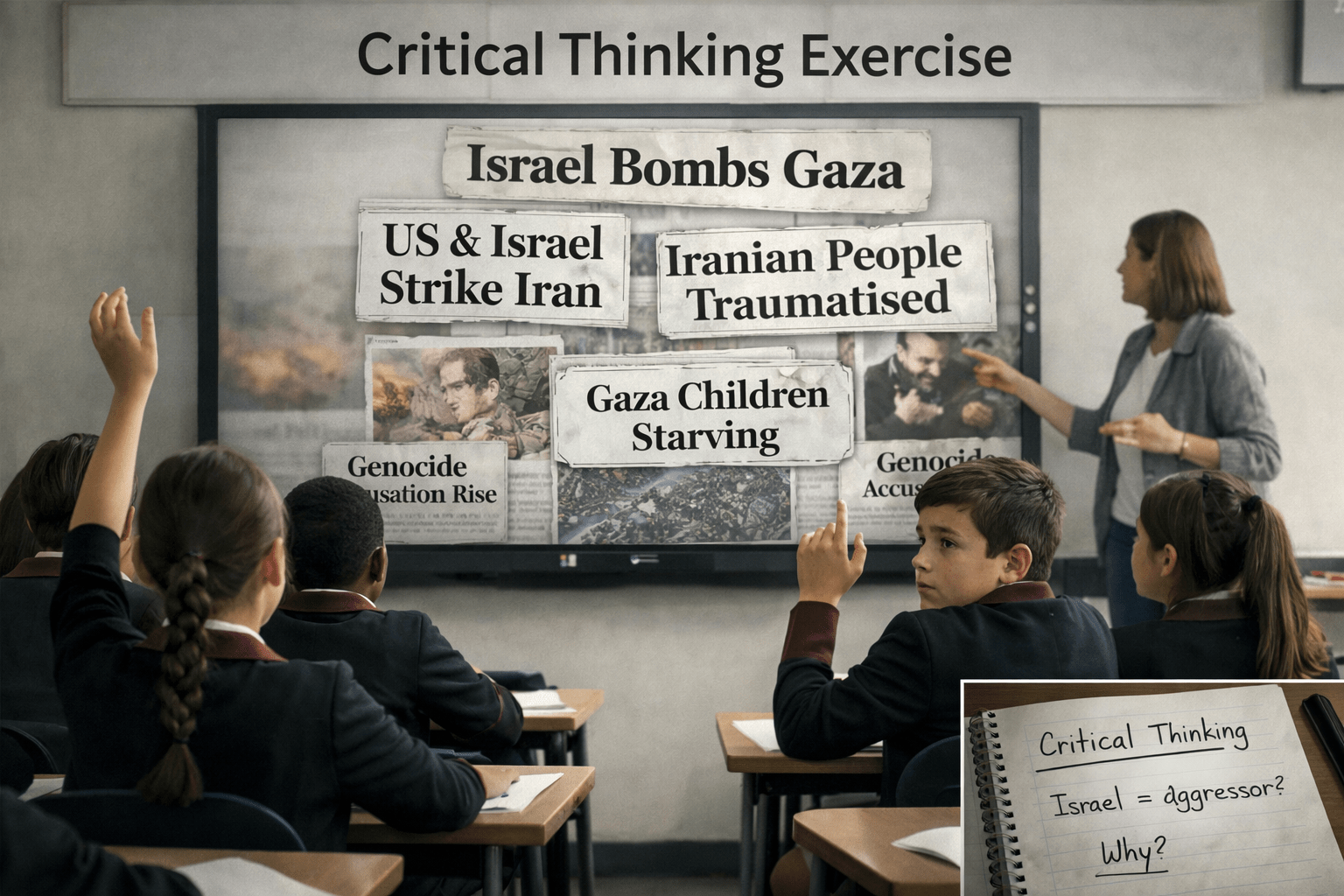
So when she came home and told me they’d had a PHSE lesson on “critical thinking”, using the conflict in the Middle East as the case study, I was actually encouraged.
This is exactly what we want, isn’t it? Don’t avoid difficult topics. Don’t dumb things down. Teach them how to engage with complexity.
But then she said something that stopped me:
“It didn’t feel balanced. It felt like it was biased against Israel.”
Now, kids can misinterpret things. Especially with topics this big. So I didn’t jump to conclusions. I asked the school for the presentation.
I read it. And that’s when the problem became very clear.
The Illusion of Balance
On the surface, the lesson looked thoughtful. It talked about conflict. It talked about suffering. It talked about escalation and the impact on civilians. It encouraged discussion and reflection. It showed newspaper headlines. All good things.
But here’s the issue: It only told one side of the story.
Israel was presented as the aggressor. The instigator. And the bully. Bombing Gaza. Attacking Iran. Escalating tensions.
There was space given, quite rightly, to the suffering of civilians in Gaza. To displacement. To fear. To loss.
But there was nothing – not a single meaningful line – about why any of this is happening. No October 7th. No mention of the massacre. The kidnappings. The fact that Israeli civilians – families, children, elderly people – were butchered in their homes. No mention of the 100,000 Israelis displaced for 2-years from Northern Israel. The farms destroyed. Livelihoods gone.
No context of decades of missile, suicide, stabbing or ramming attacks.
No mention of Iran’s role in funding, arming and directing groups whose stated aim is not peace, not coexistence – but the destruction of Israel. No history.
No acknowledgement that Jews have been repeatedly expelled, persecuted and displaced for centuries – including around 800,000 Jews forced out of Arab countries in the last century alone.
No mention of our connection to the land going back over 3,000 years.
Nothing.
You cannot teach “critical thinking” by removing half the facts. It’s like asking people to read a book with half the pages missing and then to summarise the story. It would be completely unrepresentative of the actual plot.
That’s not education. That’s narrative control.
What Happens When You Remove Context
When you strip away context, something very dangerous happens. You don’t just simplify the story. You distort it.
If a child is shown images of one side bombing and the other side suffering, with no explanation of cause, history or intent – what conclusion are they supposed to reach?
It’s obvious. They see an aggressor and a victim. They see power used against vulnerability. And because children are empathetic (as they should be), they align with the side shown as suffering.
But empathy without context is easily manipulated.
Because the reality is far more complicated – and far more uncomfortable.
Strength Isn’t a Choice. It’s a Requirement
I said this to the teacher and I stand by it:
Yes, Israel is strong. We have to be. That strength is not born out of a desire for war.
It’s not about domination or expansion or some ideological need to fight. It’s survival. If Israel is not strong, it does not exist. If Israel doesn’t exist, Jews around the globe have nobody to defend or protect them. And we’ve seen how that plays out countless times. It doesn’t end well for us.
That’s not dramatic. That’s not political. That’s just reality.
We are surrounded by groups – many backed and funded by Iran – who have been very clear, for decades, about their goals: Not borders. Not negotiations. Not coexistence.
Elimination.
So when Israel acts, it is not in a vacuum. It is not random aggression. It is almost always reactive, preventative or defensive – whether people like that framing or not.
And none of that was even hinted at in the lesson.
Peace Isn’t Built on Pretending
Of course we want peace. Every Israeli family wants peace. Every Jewish parent wants peace.
We don’t want our children going to war. We don’t want rockets, sirens, shelters, funerals.
We want normal life. School runs. Family dinners. Quiet nights.
The same things everyone else wants.
But peace is not something you can teach by pretending both sides are simply misunderstanding each other.
Peace requires honesty. It requires acknowledging intent.
It requires recognising that when one side teaches its children to live and the other side teaches its children to die as martyrs, you don’t have a symmetrical situation.
And if you don’t teach that reality, you are not preparing children to think critically. You are preparing them to think selectively.
Why This Matters So Much
This isn’t about winning an argument. It’s about how the next generation understands the world.
If young people are taught incomplete stories, they don’t just leave with gaps in knowledge. They leave with conclusions built on those gaps.
And those conclusions shape how they see people. Communities. Entire nations.
Including us.
Because when Israel is consistently presented as the aggressor – with no context – you are not just criticising a country. You are shaping how Jewish children in that classroom are seen.
How they feel. How safe they feel speaking up. How comfortable they feel being who they are.
And that really matters. More than people realise.
What Real Critical Thinking Looks Like
If we genuinely want to teach critical thinking, then we have to be brave enough to teach the whole picture.
That means:
- Acknowledging Palestinian suffering and Israeli suffering
- Teaching about Gaza and October 7
- Discussing military power and existential threat
- Exploring displacement on both sides
- Looking at history in full – not selectively
Let children wrestle with that.Let them sit in the discomfort of complexity. Let them ask hard questions.
That’s where real thinking happens. Not in curated narratives. But in honest ones.
The Bottom Line
I don’t believe the school set out to indoctrinate.
I genuinely think the intention was good. To open dialogue. To encourage thought. To engage with a difficult topic.
But intention isn’t enough. Because if you present only one perspective – no matter how well-meaning – you haven’t taught critical thinking. You’ve taught a conclusion. And dressed it up as a question.
If we want better from our children, we have to give them better to work with.
The full story. Not just the convenient parts.
Discover more from Tribe 613
Subscribe to get the latest posts sent to your email.
No responses yet