
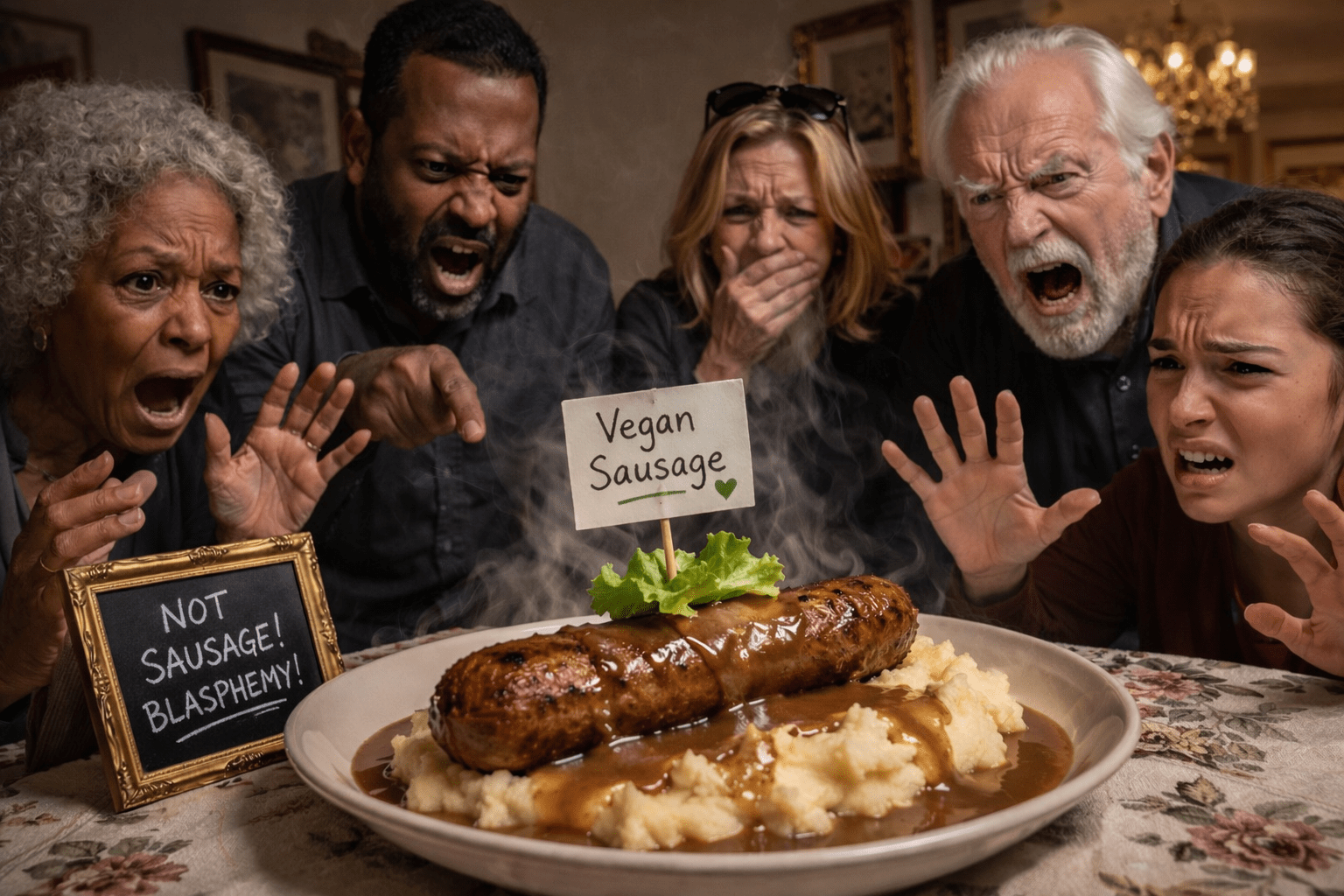
There are many strange things people choose to get upset about these days, but surely one of the oddest is this: a vegan sausage being called… a sausage.
Not because it is dangerous. Not because it is misleading. Not because some poor innocent shopper took one bite, staggered into the condiments and cried, “Sweet heavens, this wasn’t cow after all.”
No. The offence, apparently, is verbal. The word itself. The audacity of a sausage-shaped food daring to call itself a sausage when it did not once have a pulse, a snout or a passionate interest in mud.
It is a remarkable spectacle.
Some people react as though vegan food has committed identity theft. As though it has broken into the ancestral vault, pinched Nanna’s handwritten Cumberland recipe and is now living lavishly off the proceeds while the rightful meaty heirs sob quietly into their gravy.
“You can’t call that a sausage.”
Why not?
It looks like a sausage, cooks like a sausage, sits next to mash like a sausage, behaves perfectly well in a bun like a sausage and tells everyone exactly what it is trying to be. Nobody is being lured into a dark alley and tricked into tofu under false pretences.
Would it help if we renamed them?
Would the nation regain emotional stability if vegan sausages were called Burt?
“Fancy a couple of Burts for dinner?”
Or Florence?
“Pop the Florences under the grill.”
Or perhaps something entirely invented, purely to protect the feelings of people who appear to be one pea-protein cylinder away from a constitutional crisis.
Saumushlik, perhaps.
There. Problem solved. The planet keeps on turning. The village sleeps. Everyone unclenches.
Except of course it was never really about the word.
It’s about what the word implies.
Because once the familiar thing appears without the dead animal attached, people get twitchy. Not confused. Not genuinely deceived. Twitchy. Because it quietly suggests something deeply inconvenient: maybe the format was the point all along, not the corpse.
Food Language Was Already a Carnival Long Before Vegans Arrived
And this is where the whole naming tantrum starts to unravel.
Because the same people who suddenly become linguistic purists over vegan sausage somehow cope just fine with the rest of the food industry behaving like a noun free-for-all.
Peanut butter is not butter. Nobody storms into Tesco demanding a parliamentary inquiry because a peanut failed to lactate.
Coconut milk and coconut cream come from a tree, not a cow. Yet somehow civilisation has continued.
And cheese? Cheese is not a naturally occurring object like an orange or a spud. You do not find a mature cheddar growing wild beside a hedge. Cheese is a made thing. Humans take ingredients and turn them into cheese. That is the whole arrangement.
So why is vegan cheese offensive?
Yes, early vegan cheese was often grim and even I’ll about being offended by some of the early attempts. Let’s not lie to ourselves. Some of it tasted like a yoga mat with trust issues. Some had the texture of bathroom sealant. Some felt less like food and more like a prank with packaging.
But now? Some vegan cheeses are superb. Creamy, tangy, smoky, melty, rich. Not “good for vegan cheese.” Just good. Full stop.
And still some people say “vegan cheese” in the tone usually reserved for grave desecration.
The Real Label Panic Is on the Back, Not the Front
Which is especially funny if, like me, you have spent years reading labels with the focus of a bomb disposal expert.
Because this is the bit that gets me. People suddenly become deeply concerned about what words on food packets mean, but not in the useful way.
Not in the “is this actually good for my gut or my brain?” way.
Not in the “let me check whether this contains gelatine” way.
Not in the “hang on, why is there milk powder in this?” way.
Not in the “of course they’ve used high fructose corn syrup and it’s going to spike my blood sugar” way.
That kind of label-reading, the practical sort, the sort where you are trying to work out whether your food contains bits of an animal that had absolutely no business turning up in your lunch or if what you’re about to eat is actually good for you, somehow doesn’t inspire nearly the same public passion.
I’ve spent enough time scanning ingredient lists to know that food manufacturers are perfectly capable of sneaking animal products into places they have no business being. Gelatine lurking where nobody asked for it. Rennet popping up like a tiny bovine landmine. Milk stuffed into things that looked perfectly innocent five seconds earlier. A couple of extra grams of totally unnecessary refined sugar, exactly what I need when I’ve finally got my blood glucose to play nicely.
So spare me the dramatic concern over a vegan sausage using the word sausage. The real label chaos is not in the name on the front. It’s in the ingredients list on the back, where half the population seems happy to sleepwalk past the actual contents while staging a moral panic over the font.
These Are Formats, Not Royal Bloodlines
The whole objection gets sillier still the second you apply it consistently.
Chicken shawarma is not offended by lamb shawarma. A bean burger is not lying awake at night feeling threatened by a beef burger. Nobody has ever stared at a menu and demanded legal counsel because two foods share a format.
Because that is what these names usually describe: the format.
A burger means a patty in a bun.
Shawarma means the spiced, sliced, stuffed-into-bread arrangement.
A sausage means the cylindrical item you eat with mash, mustard or at 11:47pm while making dubious choices your daytime self will deny in court.
These are culinary categories, not hereditary titles reserved only for the descendants of the slaughtered.
Vegan Chicken, Roger and the Great Public Brain Fog
And then we come to vegan chicken, which seems to produce a very particular kind of brain fog in some meat eaters.
This one, to be fair, is trickier for them because chicken is both the name of the animal and the name of the food. So the objection arrives with extra confidence, as though they have finally found the killer argument to eradicate those pesky plant-based peeps.
“You can’t call it chicken. It isn’t chicken.”
Right. And would it somehow be less offensive if it were called Roger?
Or Paulette?
Would everyone finally relax if the packet said:
Plant-Based Paulette Pieces – Ideal for fajitas, curries and preserving social order.
Because let’s be honest, nobody is confused.
Nobody is taking home vegan chicken pieces, opening the packet and gasping, “Hang on, this didn’t come from an actual bird?” The word is doing what food words do all the time. It tells you the role it plays on the plate. The flavour profile. The texture. The job.
It means chicken-style.
It does not mean a hen was consulted.
We Objected to the Killing, Neville. Not the Seasoning
And then, right on cue, comes the question delivered with the smugness of a person who thinks they have just single-handedly defeated veganism while buttering their toast:
“If you hate meat so much, why eat vegan chicken?”
“If you’re against bacon, why make vegan bacon?”
Because we were objecting to the killing, Neville. Not the seasoning.
This really should not be difficult.
Most vegans did not wake up one morning and think, “You know what I can no longer tolerate? Smoky flavour. Crisp edges. Juicy texture. A nice chew. Marinade. Garlic. Herbs. Salt doing what salt has always done magnificently.”
No. The issue was the suffering. The confinement. The killing. The completely unnecessary brutality involved in getting that flavour and texture onto a plate.
Take away the slaughterhouse, the fear, the blood and the bolt gun and what are you left with?
Texture. Flavour. Smoke. Crunch. Succulence. Satisfaction.
Turns out those bits were never the problem.
People like food. That is the shocking revelation at the heart of all this. They like familiar tastes, familiar textures, familiar formats. What they object to is the tiny administrative inconvenience of a sentient being having to be bred, confined and killed for it.
That’s all.
The Family Dog Problem Nobody Likes Talking About
And this is where the conversation gets properly awkward, because it turns out people are not nearly as morally consistent as they imagine themselves to be.
Take the family dog.
Rex. Buddy. Butch. Princess. Sir Barksalot of Buckinghamshire.
That sacred four-legged member of the household who gets birthday treats, nicknames, expensive medical insurance and a place by the fireplace. The one people refer to as “my baby” while showing you nineteen photos of him asleep in seasonal knitwear.
Lovely.
But move the map a little and the moral certainty starts perspiring.
Dog here: cherished family member.
Dog elsewhere: lunch.
Cow here: Sunday roast with braised carrots.
Cow there: sacred animal roaming down the street.
Horse here: cute ponies and race thoroughbreds.
Horse there: served with potatoes dauphinoise, rare.
Bug here: revolting, annoying, buzzy, jumpy things.
Bug elsewhere: protein snack.
And suddenly the whole thing looks less like ethics and more like geography with good PR.
That is the bit people hate.
We like pretending our food choices are rooted in some grand moral truth, when often they are just whatever culture handed us, whatever our family cooked, wherever we grew up and whatever nobody questioned loudly enough to ruin Sunday lunch.
And here’s the awkward bit wrapped in an even more awkward bow: cows and pigs have been shown again and again to be social, curious, emotionally responsive creatures. They recognise individuals. They form bonds. They care for their young. They feel fear. They feel distress. They are not beige garden furniture with eyelashes.
So if a dog gets a name, a memory-foam bed and a family WhatsApp update when it sneezes, while a cow gets stunned, sliced and sold in clingfilm, the question is fairly obvious:
Why does one animal get cuddles and the other gets gravy?
That is not a moral framework.
That is culture in a sensible cardigan pretending to be philosophy.
The Part I Actually Struggle With
I have a friend who has no issue watching animals killed in an abattoir. None. To her, animals are products. Units. Stock. Inventory with eyeballs. Not gentle, harmless, sentient beings. Just things. Raw ingredients in fur.
And that, for me, is the real issue.
Not whether someone eats meat. Not whether they grew up on roast dinners.
Not whether their uncle becomes National Geographic after two lagers and starts mumbling about the food chain as though he personally negotiated it with evolution.
The issue is whether we can look at an animal that feels fear, forms bonds and clearly wants to stay alive, and reduce it to “thing I enjoy with chips.”
Because once you do that, everything else becomes easier. The suffering becomes background noise. The fear becomes process. The killing becomes “industry,” which is a very tidy word for something so grotesque.
The Ethical Costume Change
Then comes my favourite routine of all:
“I only eat pasture-fed.”
“I only buy free-range.”
“My meat is local.”
Right. So the victim had a nicer view beforehand.
This is always offered up as though it settles the matter. As if the cow, moments before death, was thinking, “Well, this is obviously upsetting, but in fairness, the meadow was lovely.”
I know people say this to reassure themselves, but it is a strange defence. It is like arguing that being pushed off a cliff becomes ethically elevated if the walk up there was scenic.
And that is the real trick here. People cling to the labels because the labels are easier. It is much more comfortable to get upset about nouns than to sit quietly with the reality of what those nouns are replacing.
Because once sausage can be made of plants, once milk can come from oats or beans, once chicken can exist without an actual chicken and once bacon can provide salt, smoke and crispness without the corpse of a pig, the old excuses start coughing a bit.
Suddenly it is no longer “this is just how the world works.”
Suddenly it is “this is what I’m used to.”
And those are not even remotely the same sentence.
So What’s Actually Offending People Here?
So no, I am not terribly worried about whether my vegan sausage, vegan chicken, vegan bacon or vegan cheese offends someone’s sense of culinary purity.
Call it sausage. Call it chicken. Call it bacon. Call it cheese. Call it Burt, Roger, Paulette, Florence or Saumushlik if it helps everyone rediscover perspective.
But let’s be honest about what is actually happening here.
This was never really about words. It was about the fact that the swap looks possible. Normal. Easy, even.
And that is what unsettles people. Not because they are confused, but because they are not. They understand perfectly well what is being questioned.
And if a plant-based bacon strip using the word bacon feels more offensive than the pain inflicted on the animal version, then perhaps the issue is not the label.
Perhaps the issue is that society’s moral compass is so badly calibrated it can spot a vegan sausage from fifty paces, yet somehow goes mysteriously blind the moment an actual animal suffers to make the “proper” one.
Discover more from Tribe 613
Subscribe to get the latest posts sent to your email.
No responses yet