
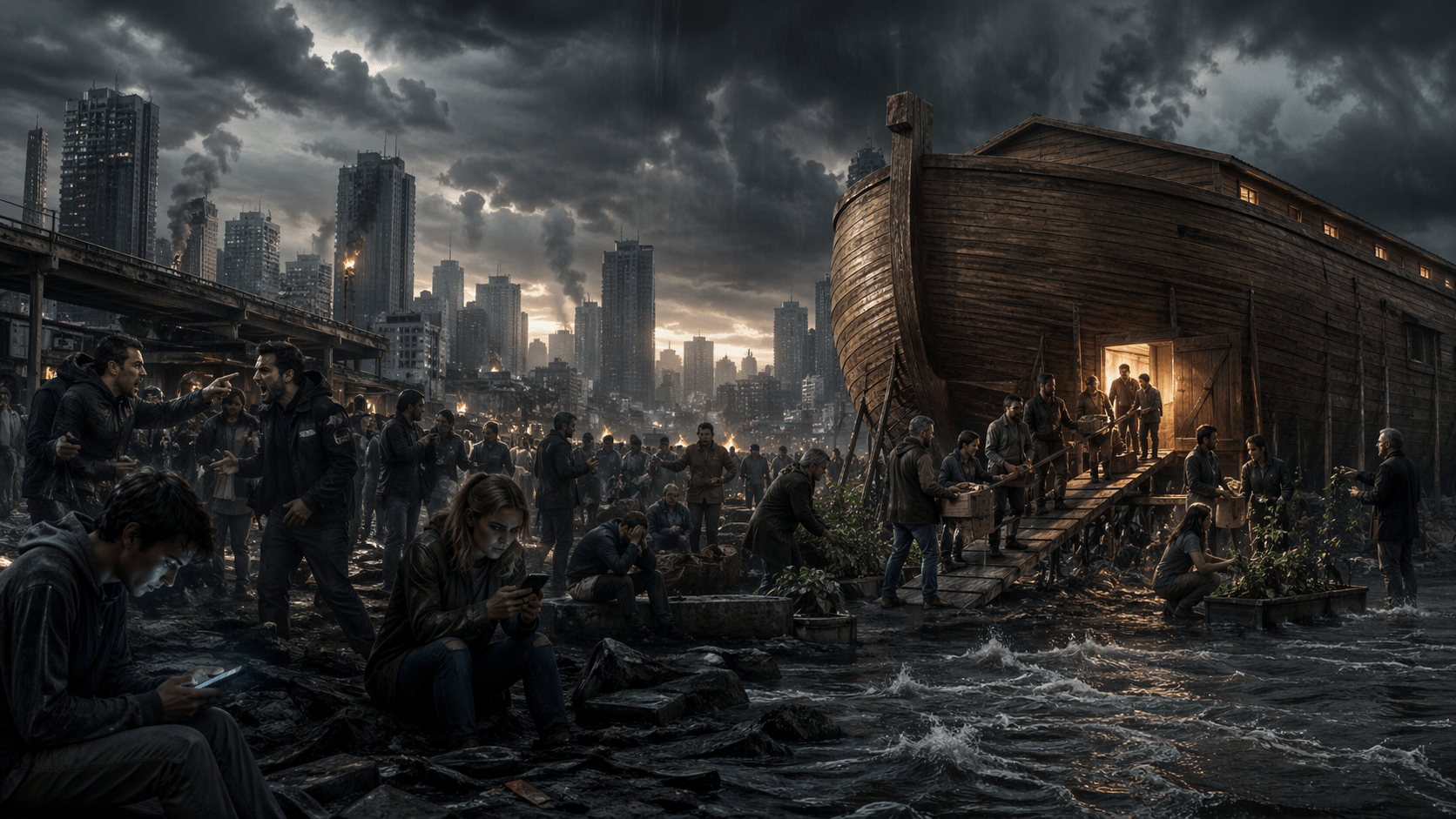
I’ve been re-reading my Noah story from Legends of the Light and, hand on heart, I’m a bit stunned by how much of it feels like a commentary on the world we’re living in right now.
When you hear the story as a kid, it’s all very wholesome and storybook, isn’t it? Animals in pairs, a giant boat, a dove with a leaf in its beak, a rainbow at the end. Very lovely. Very calming. Very “let’s paint this on the nursery wall and pretend it’s about giraffes.”
But then you read it again properly as an adult and realise it’s not really about the animals at all.
It’s about a civilisation that had become so rotten, so selfish, so violent, so indifferent, so morally corroded, that you could barely describe it as civilised anymore.
And that, frankly, feels a bit too familiar.
Because here we are in 2026, with more knowledge than any human civilisation in history, more access to information, more technology, more science, more medicine, more communication, more convenience, more everything… and yet so much of the world feels like it’s being run by ego, rage, vanity, tribalism, greed, cowardice and the emotional maturity of a year 7 playground drama.
Honestly, it would be laughable if it weren’t so sad.
We’ve Never Been Smarter. We’ve Also Never Been This Spiritually Stunted
That’s the bit that really gets me.
Humanity is extraordinary. Truly. We can do things our ancestors would have considered pure sorcery. We can replace joints, map genes, speak to someone on the other side of the planet in realtime from the palm of our hand, ask a machine to write code or explain astrophysics and carry the sum total of human knowledge around in our pockets while standing in Tesco trying to remember why we went in there in the first place.
And yet, for all this brilliance, so much of modern life feels like we’re heading backwards.
Not technologically.
Morally. Emotionally. Spiritually. Civilisationally.
We are, in so many ways, speaking downward.
Not upward into wisdom. Not upward into responsibility. Not upward into truth, decency, discipline or care.
Downward into noise. Downward into outrage. Downward into “look at me.” Downward into self-obsession. Downward into moral laziness dressed up as sophistication. Downward into endless commentary from people who seem to think having a platform is the same thing as having something worth saying.
And yes, I know, there are good people too. Obviously there are. Amazing people: Builders. Teachers. Healers. Helpers. Quiet, decent people doing the heavy lifting, real work of raising families, caring for others, trying to leave the world less ugly than they found it.
But let’s not kid ourselves. They are increasingly swimming against a tide of absolute drivel.
The Flood Didn’t Begin with Rain
That’s what struck me hardest reading Noah again. The rain wasn’t the real disaster.
The disaster had already happened.
The flood was just the end result.
The real collapse began when a society stopped caring about right and wrong. When selfishness became normal. When cruelty became casual. When violence became ordinary. When people stopped using their privilege and intelligence to build anything good and instead, started using them to enrich themselves, excuse themselves, glorify themselves, reward themselves or ignore the wreckage around them.
That’s when the world began to drown.
And that feels painfully close to home right now.
Because our modern flood is not made of water.
It’s made of ego. Indifference. Performative morality. Cowardice. Corruption. Narcissism. Selective compassion. Mindless self-promotion. Clickbait. Endless likes 👍🏽.
And that particularly modern disease of seeing everything through the lens of “how does this help or affect me?”
We’ve become a civilisation of cameras, microphones and likes.
Everybody broadcasting. Everybody reacting. Everybody branding. Everybody announcing.
Almost nobody is actually listening, thinking, reflecting, building, repairing, caring. Truly caring.
We’ve got a surplus of visibility and a famine of depth.
Noah Didn’t Build a Brand. He Built an Ark
And there, buried in this ancient story, is the bit I think matters most.
Noah looked at a broken world and did not become part of the rot.
He built something different.
He preserved life in a time of destruction. He protected what mattered while everything around him was going to pieces. He chose discipline over chaos, obedience over ego, purpose over performance.
He built an ark.
Not a brand. Not a following. Not a personal empire. Not a clever identity with a nice logo and a deeply moving bio.
An ark.
Something useful. Something life-preserving. Something that could carry the future through the madness.
That hits hard, because we are living in an age where far too many people want to be seen to be building rather than actually build anything worth a damn.
Everything is optics. Everything is posturing. Everything is “notice me having values. Everything is curated. Everything is aesthetic. Everything is content.
Meanwhile, the actual work of holding families together, strengthening communities, teaching children, helping the vulnerable, telling the truth, standing up to madness, preserving decency, building trust, creating something of real worth… that stuff gets less applause because it’s not glamorous. It’s not viral.
It’s just vital.
Not Everybody Is Evil. Plenty Are Just Indifferent
And that, if I’m honest, may be even more chilling.
Because the Noah story isn’t only about obviously wicked people twirling their metaphorical moustaches and being terrible. It’s also about a society that had grown numb and accustomed. A society where enough people either joined in the rot, benefited from it, excused it or simply couldn’t be bothered to challenge it.
That’s always how decline works.
You don’t need every person to be monstrous. You just need enough people to shrug.
Enough people to say:
“Not my problem.”
“Bit complicated.”
“There are bad people on both sides.”
“I’m sure there’s context.”
“I just don’t want to get involved.”
Right. Lovely. Thanks very much. That’ll definitely save civilisation.
As the famous saying goes, “the only thing necessary for the triumph of evil is for good people to do nothing.”
And that is precisely the danger. Not just evil itself, but the silence, passivity and indifference that allow it to get comfortable and unpack its bags.
Indifference is one of the great accelerants of decay. It allows evil to stroll about in broad daylight while decent people convince themselves that staying comfortable is somehow the mature option.
It isn’t. It’s just passivity with better PR.
We Know Too Much to Be This Morally Pathetic
That’s the great irony.
We know what hatred does. We know what propaganda does. We know what dehumanisation does. We know what happens when societies become coarser, crueler, more cynical, more selfish and less anchored to truth.
We know this.
We have history. We have books. We have testimonies. We have footage. We have evidence. We have every warning sign imaginable flashing like a big red neon light.
And still, so much of the world behaves like a civilisation standing in a petrol station, surrounded by smoke, flicking a lighter and asking whether anyone smells anything funny.
At some point you do have to ask: with all this intelligence, all this education, all this access to information, why are so many people still so morally useless when it counts?
Harsh? Maybe.
But not wrong.
So What Do We Do?
That’s why Noah matters.
Not because I think the lesson is “panic, doom, everyone buy a boat.”
The lesson is this:
When the world around you is sliding into selfishness, vulgarity, cruelty and chaos, you do not join it. You do not normalise it. You do not excuse it. And you do not sit there with your arms folded, rolling your eyes, acting as though trying to preserve what is good is somehow naïve.
You build.
You build upward while the culture speaks downward.
You build family. You build character. You build faith. You build courage. You build communities with backbone. You build words that clarify instead of confuse. You build spaces where truth still matters and human beings are treated as human beings, not avatars for political convenience.
You build an ark.
Not because it’s trendy. Not because everyone will clap. Not because the world suddenly deserves it.
But because without ark-builders, everything goes under.
That’s the Choice, Really
That’s where I’ve landed after reading Noah again.
The story isn’t ancient in the dusty, irrelevant sense. It’s ancient in the deeply uncomfortable, horribly current, “why does this still describe us so well?” sense.
We are living in a time of immense brilliance and frightening moral silliness. A time when humanity can do almost anything except, apparently, govern its own ego.
A time when too many people are using astonishing tools for pitiful ends. A time when the loudest voices are often the least wise and the most self-absorbed. A time when indifference is marketed as balance, cowardice as nuance and noise as truth.
And yet.
There are still builders. There are still people who haven’t lost the plot.
Still people trying to use their minds, their hands, their words, their energy and their lives for something bigger than themselves. Still people trying to benefit mankind rather than merely extract from it. Still people trying to bring light rather than more floodwater.
That’s the job. Always has been.
So perhaps the real lesson of Noah for our age is not “look how bad they were.”
It’s: Don’t become them. When the world is sinking into madness, selfishness and moral filth, don’t add to the water.
Build an ark.
Discover more from Tribe 613
Subscribe to get the latest posts sent to your email.
No responses yet