
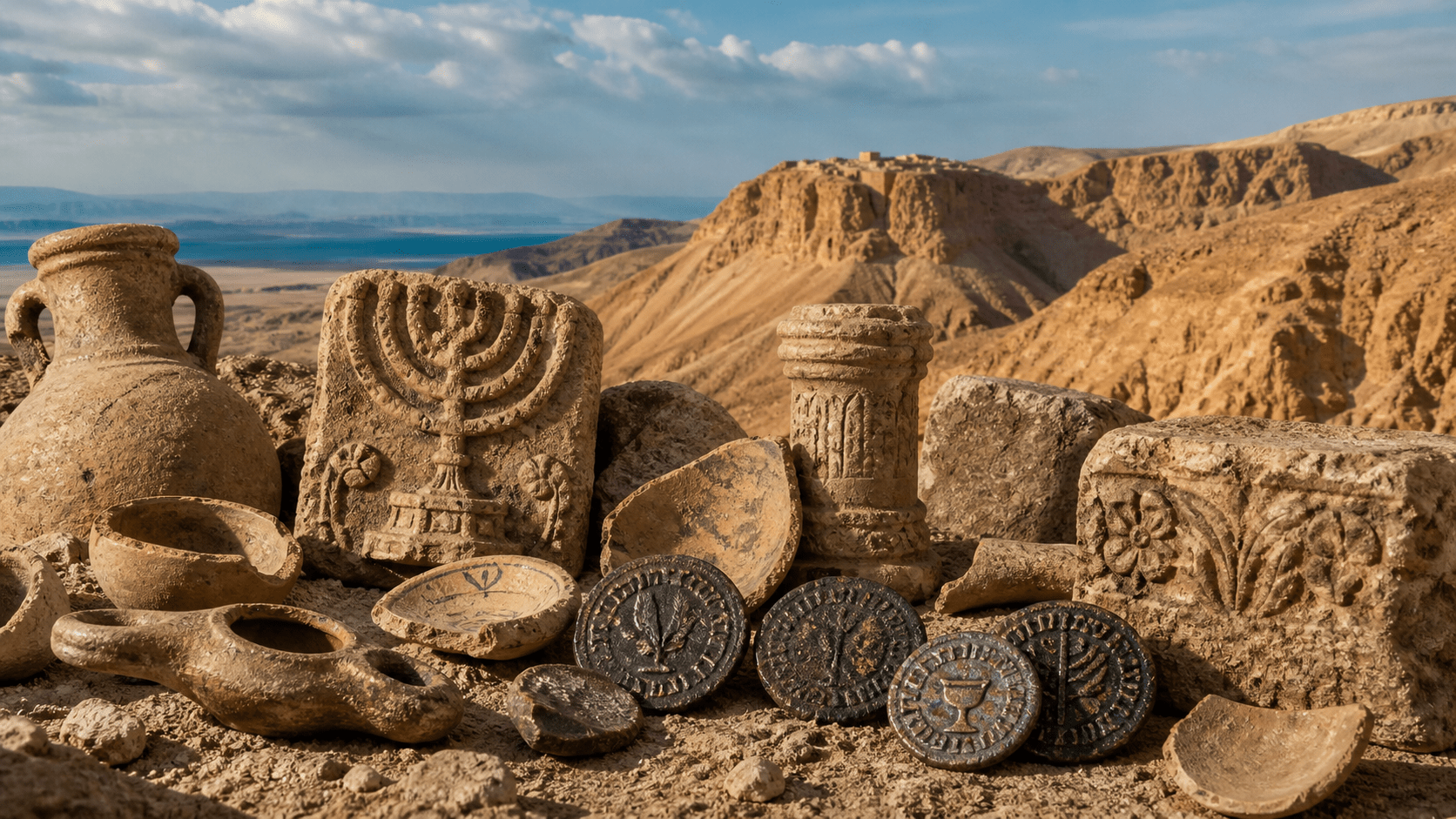
There are places in the world where you dig a hole and find clay.
In Israel, you dig a hole and accidentally interrupt a conversation that started three thousand years ago.
You cannot throw a stone without first checking whether it is, in fact, an ancient Jewish archaeological artefact, a Second Temple drainage cover, a Roman-era sling stone or the missing corner of someone’s great-great-great-great-great-great-great-grandmother’s cooking pot.
Which, admittedly, makes gardening slightly more complicated.
Want to build a house? Lovely. Forget the architects – first, please consult the archaeologists.
Want to extend a road? Wonderful. Just make sure you are not casually bulldozing through an ancient village, wine press, mikveh, synagogue, burial cave, olive press, farm terrace, city wall or some other deeply inconvenient proof that Jews did not wander into the story last Tuesday carrying a flag, a hummus recipe and suspiciously strong opinions about how long to boil an egg.
Israel is not just a country. It is a national archive with traffic lights.
Several years ago, I was walking up a hill in northern Israel. Nothing dramatic. No Indiana Jones hat. No orchestral music. Just me, a dusty gravel path and a slope with the attitude of a gym instructor.
And there, scattered among the stones, were thousands of fragments of ancient pottery. Not behind glass. Not inside a museum. Not arranged neatly with a small plaque saying, “Please admire this shard responsibly.”
Just there. Underfoot. Among the gravel.
Pieces of lives that had been lived. Meals that had been cooked. Water that had been carried. Hands that had shaped clay. Families that had existed, laughed, argued, prayed, worked, loved and left tiny ceramic whispers behind them.
You do not need to be an archaeologist in Israel to feel history. You just need to look down.
And sometimes, you do not even need to be tall enough to reach the top shelf.
In 2015, an eight-year-old Israeli boy called Itai Halperin was walking with his family near Tel Beit Shemesh when he spotted a small ceramic object on the ground. Most children pick up sticks, interesting stones or something nasty that no parent ever want to explain. Itai picked up a 3,000-year-old figurine head from the First Temple period.
In some countries, an eight-year-old finds a football card. In Israel, an eight-year-old goes for a walk and accidentally hands the state another piece of ancient Judean civilisation.
And this is not some freak one-off. A hiker near the Horns of Hittim by Tiberias found a 3,500-year-old Egyptian scarab amulet. A seven-year-old at Tel Rehov in the Beit She’an Valley uncovered a 3,400-year-old clay figurine while climbing an archaeological mound with friends.
This is the absurdly beautiful thing about Israel. Even childhood walks come with footnotes. One minute you are kicking stones along a path. The next, history clears its throat and says: “Actually, I was here first.”
Another time, I was driving up a winding road in the hills above Afula. The road bent strangely around a huge rock, the size of a small house. It looked almost offended by modern planning. As if the road had approached it, clipboard in hand and the rock had simply said, “No.”
So one day I stopped and climbed onto it, because apparently, I am exactly the sort of person who sees a mysterious giant rock and thinks, “Yes, let’s scale that.”
And there it was.
The rock was not just a rock. It was an ancient wine press, thousands of years old. A place where people once brought grapes from the surrounding hills, crushed them, gathered the juice, made wine, celebrated harvests, marked festivals, shared cups, told stories, watched children run between the vines and probably complained about the price of everything because some traditions are eternal.
And suddenly the road made sense. It was not awkwardly avoiding a boulder. It was bending around history.
That is Israel. The land does not just contain history. History literally keeps bumping into your ankles. Which, naturally, is terribly inconvenient for the modern TikTok historian.
Not real historians. Not proper archaeologists. Not the people spending years in dusty trenches, patiently identifying pottery rims, soil layers, scripts and carbon dates while the rest of us get excited because something looks vaguely old and has a nice crack in it.
I mean the other sort:
The keyboard historian. The placard scholar. The keffiyeh-clad PhD in Advanced Hashtag Studies. The purple-haired, soya-frothed latte brigade in trousers that look like they were stolen from a nine-year-old.
The ones who discovered the Middle East five minutes ago through a three-slide Instagram carousel and now feel qualified to explain three thousand years of Jewish history to Jews.
Their argument, if we can dignify it with the word, seems to be that Jews are basically white Europeans from Poland who parachuted into existence in 1948 with a suspiciously good PR department and an unreasonable attachment to Jerusalem.
Which is a bold theory.
All you have to do is ignore Egyptian inscriptions, Aramaic inscriptions, Moabite inscriptions, Assyrian records, Persian policy, Roman monuments, Hebrew seals, Hebrew letters, biblical scrolls, Temple artefacts, ancient coins, Jerusalem, the Kotel, the Dead Sea Scrolls, half the Jewish world that is not Ashkenazi and the inconvenient fact that our enemies kept writing us down.
Apart from that, it’s flawless. Great job Indiana.
But then, uncomfortably, the artefacts walk into the room. And they do not care about your feelings. They do not care about your slogan. They do not care how many times someone shouts “coloniser” into a reusable water bottle.
They just sit there, in stone, silver, clay and ink, quietly destroying nonsense.
There is the Merneptah Stele, around 1208 BCE, an Egyptian victory inscription naming Israel among peoples in Canaan. That means a people called Israel were known in the land in the late thirteenth century BCE.
Not 1948. Not 1917. Not “after the Holocaust.”
Around 1208 BCE.
That is roughly 3,200 years ago, for those whose historical timeline begins at “my lecturer said…” and ends at “link in bio.”
Then there is the Tel Dan Stele, from the ninth century BCE, found in northern Israel, referring to the “House of David.” Not a bedtime story. Not a later European fantasy. A royal dynasty remembered outside the Bible.
Ninth century BCE. Or, for those who need to take off their shoes to count past ten, roughly 2,800 years ago.
Then the Mesha Stele, also from the ninth century BCE, a Moabite royal inscription describing conflict with Israel. Even Moab, not exactly our fan club, knew Israel was there.
How careless of them not to consult a student union motion before chiselling.
Then come the Ketef Hinnom Silver Scrolls, tiny silver amulets found in Jerusalem, dating to the late seventh or early sixth century BCE, containing a version of the Priestly Blessing from Numbers:
“May the Lord bless you and keep you…”
A biblical blessing. In Hebrew. In Jerusalem. Before the Babylonian destruction.
Roughly 2,600 years old. Tiny silver scrolls. Biblical Hebrew. Jerusalem.
Not exactly screaming “freshly imported from Poland,” is it?
Then there is Hezekiah’s Tunnel and the Siloam Inscription, an ancient Hebrew inscription inside Jerusalem’s water system, recording the moment two teams of diggers met underground while cutting through rock. First Temple Jerusalem: engineering, Hebrew literacy, water defence, biblical geography, all in one damp stone corridor.
Eighth century BCE.
About 2,700 years ago, give or take a sandal. Quite a long time before modern keyboard historians began bravely excavating their truth from TikTok comments.
Then the Taylor Prism, also known as the Sennacherib Prism, records Assyria’s campaign and mentions tribute from Hezekiah, king of Judah, in 701 BCE.
Judah. Hezekiah. Assyria. Written by Assyrians.
A little inconvenient, unless one plans to accuse ancient Mesopotamia of Zionist lobbying.
Then the Lachish Reliefs show Assyria’s siege and capture of Lachish, one of Judah’s major cities. The Lachish Letters, written in Hebrew on pottery shards shortly before the Babylonian destruction, give us military messages from Judah’s final desperate days.
Pottery with better historical literacy than half the people shouting “educate yourself” in comment sections.
Then there is the Hezekiah Bulla, a tiny clay seal impression found in Jerusalem reading:
“Belonging to Hezekiah, son of Ahaz, king of Judah.”
Small enough to lose in a pocket. Heavy enough to flatten any bad argument.
Then the Cyrus Cylinder, which does not mention Jews or Jerusalem directly, because we do not need to exaggerate when the truth is already wearing armour. What it does show is Cyrus the Great’s policy of restoring temples and returning displaced peoples after conquering Babylon. That fits the wider Persian world behind the biblical account of Jewish return from exile.
In other words, even ancient Persian imperial policy understood return better than some people with Wi-Fi and editing software.
Then the Dead Sea Scrolls, dating from the third century BCE to the first century CE, preserve ancient Jewish biblical manuscripts and show the textual world of Second Temple Judaism.
Ancient Hebrew texts. In the land. Before Christianity became a world religion. Before Islam existed. Before TikTok turned historical illiteracy into a lighting style.
Around 2,000 to 2,300 years ago, depending on the manuscript. Ancient Jewish texts, copied and preserved in the land, before half the world’s religions had finished unpacking their theological suitcases.
And finally, the Temple Warning Inscription, a Greek inscription from the Second Temple complex warning non-Jews not to pass beyond the permitted boundary.
A literal ancient “do not enter” sign from the Jewish Temple courts.
Not a metaphor. Not a vibe. Not a “contested narrative.”
A sign. From the Temple. In Jerusalem.
Around 2,000 years old. Which, in fairness, is still younger than some of the arguments people are making against us.
So let’s review the problem for the frothed-latte revolutionaries.
Israel was known in Canaan by around 1208 BCE. Israel and Judah were real kingdoms. A Davidic royal house was remembered outside the Bible. Hebrew writing, administration and worship existed in First Temple Jerusalem and Judah. Assyria and Babylon’s pressure on Judah is archaeologically visible. The exile-and-return world fits Persian imperial policy. Second Temple Judaism, Temple boundaries, biblical manuscripts and Jewish ritual life are physically attested. A people called Israel were there. A kingdom called Judah was there. Jerusalem was there. Hebrew was there. The Temple stood there. Our texts were copied, carried, guarded and lived. Phew! Pause for breath…
That is not a footnote. That is a 3,000-year-old paper trail written in stone, silver, clay and stubbornness.
And then, of course, there is Jerusalem. There is the Kotel, the Western Wall.
Not a decorative old wall. Not a spiritual selfie backdrop. Not some vague ancient “place of interest” where tourists nod politely before asking where the nearest café is.
The Kotel is part of the retaining wall surrounding the Temple Mount, the site of the First and Second Temples. The Second Temple was completed in 515 BCE and destroyed by the Romans in 70 CE.
Let that land for a moment.
The Romans destroyed the Temple in 70 CE. Not “a rumour.” Not “a myth.” Not “a Zionist invention.”
Rome knew it. Jews knew it. History knows it. The stones know it.
And if someone insists on dismissing Jewish memory, Jewish scripture, Jewish archaeology and Jewish continuity because Jews are apparently not allowed to narrate our own history, fine.
Have Rome. Rome remembered us. Not fondly, obviously. Rome did not exactly send a sympathy card and a fruit basket after destroying Jerusalem. But it remembered us in stone.
Walk through Rome and you will find the Arch of Titus, built after the Roman destruction of Jerusalem, commemorating Titus’s victory over the Jewish revolt.
And carved into that arch, for all the world to see, are Roman soldiers carrying away the sacred treasures from the Temple in Jerusalem, including the menorah.
They were not ransacking a rumour. They were not parading away a metaphor. They were looting the Jewish Temple. In Jerusalem. In 70 CE.
Rome wanted that arch to say: “We defeated them.”
Instead, two thousand years later, it says: “They were there.”
That must be irritating when your entire worldview depends on pretending we were not.
And yes, Israel is not a single-layer cake. It is historical baklava. Canaanite, Israelite, Judean, Babylonian, Persian, Greek, Roman, Byzantine, Arab, Crusader, Ottoman, British, modern Israeli. Layer upon layer, people upon people, empire upon empire.
But pretending the Jewish layer is not there is not scholarship. It is vandalism in a keffiyeh and sandals.
And this is where some parts of modern academia lose the plot.
Again, not real scholarship. Serious archaeology gave us much of this evidence. Serious historians study these inscriptions, argue over dating, publish translations, challenge assumptions and make the picture clearer.
That is scholarship. That is valuable.
What we are talking about is activist academia. Ideology wearing a face mask. People starting with the conclusion, then rummaging through history looking for anything that can be bent into shape without snapping too loudly.
When every inscription, scroll, coin, seal, tunnel, relief, letter and Temple artefact is dismissed because it does not fit the approved slogan, perhaps the problem is not the evidence.
Perhaps the problem is that your theory has wandered into a room full of facts wearing papier-mâché armour.
So no, we do not need a lecture from someone whose knowledge of Jewish history began last semester and whose research method appears to be “watch, repost, shout, repeat.”
No, we do not need to be told Jews are “really Europeans” by someone who has never met a Yemenite Jew, Ethiopian Jew, Iraqi Jew, Moroccan Jew, Iranian Jew, Kurdish Jew, Indian Jew, Syrian Jew, Libyan Jew, Tunisian Jew, Bukharian Jew, or, apparently, a mirror or a shower.
No, we do not need TikTok’s Department of Confident Nonsense to explain away three millennia of evidence because the facts refuse to kneel politely before a slogan.
The Jewish connection to the Land of Israel is not hidden in footnotes.
It is carved into walls. Stamped into coins. Buried in floors. Etched into inscriptions. Baked into pottery. Pressed into wine installations. Recorded by enemies. Mourned in prayers. Sung in longing. And preserved in a people who somehow refused to vanish.
Before Christianity existed, before the New Testament had even got its sandals on, before Jesus, a Jewish man from Judea, became the central figure of another world religion, we were already there.
Before Islam was born in Arabia in the seventh century CE, before Muhammad, before caliphates, before domes and minarets and modern slogans printed on polyester flags, we were already there.
These are not insults. They are dates. Terribly inconvenient little things, dates. They just sit there, refusing to rearrange themselves for whoever has the loudest megaphone, the tightest trousers or the most aggressively foamed chickpea latte.
So even if someone wants to throw out Jewish sources, fine.
Have Egyptian inscriptions. Have Aramaic inscriptions. Have Moabite inscriptions. Have Assyrian prisms. Have Assyrian palace reliefs. Have Persian imperial policy. Have Greek Temple warning signs. Have Hebrew letters. Have silver scrolls. Have clay seals. Have manuscripts. Have coins. Have ruins. Have sacred texts that pre-date your student union motion by several millennia and, frankly, have better grammar.
At some point, the denial stops being ignorance and becomes performance art.
And to those people, with their borrowed outrage, reheated slogans, designer victimhood and frothed chickpea milk lattes, the stones offer a simple, dignified response:
Sit down. The adults are talking.
Because the stones are not confused. The Egyptians were not confused. The Moabites were not confused. The Assyrians were not confused. The Babylonians were not confused. The Persians were not confused. The Romans were not confused. Even our enemies remembered us.
The only people confused are the ones who arrived at the end of a three-thousand-year conversation and started shouting over the evidence.
In Israel, history is not safely locked away in dusty academic rooms. It is in the hills. It is in the stones. It is under the roads. It is in the caves, terraces, tunnels, walls and ruins. It is in the fact that construction projects often require archaeological checks and where ancient remains are found, building may pause while proper investigations take place.
Imagine trying to put in a car park and discovering that your future parking bay number seven is sitting on top of someone’s ancient wine press.
Only in Israel could a contractor start the morning thinking about drainage and end the day wondering whether King David’s distant cousin once stored olives there.
That is the thing about this land. It refuses to behave like a blank page. It is full of handwriting. Some of it is cracked. Some of it is buried. Some of it is half-erased by conquest, weather, war, neglect, time and the heavy boots of empires.
But it is still there. A shard here. A wall there. A press on a hill. A coin in the soil. A mikveh beneath a street. A Hebrew inscription. A synagogue mosaic. A prayer at the Kotel. A road that bends around memory because even modern asphalt sometimes has the decency to show respect.
That is not colonisation. That is continuity. That is not fabrication. That is excavation. That is not a people inventing roots.
That is a people tripping over them. And perhaps that is what bothers some people most.
Not that Jews have returned to Israel, but that the land keeps recognising us. The stones are awkward witnesses. They do not chant. They do not tweet. They do not care what some overconfident student union motion declared last Thursday.
They just sit there, quiet and immovable, holding the evidence.
So when someone tells you Jews have no ancient connection to Israel, what they are really saying is: “I have decided not to know things.”
And that is their choice.
But it does not change the pottery beneath the path. It does not change the ancient wine press above Afula. It does not change the Kotel. It does not change Jerusalem. It does not change the inscriptions, the coins, the ruins, the prayers, the festivals, the language, the longing, the exile, the return. It does not change the fact that for thousands of years, Jews faced Jerusalem when they prayed. Stamped on glasses at weddings to remember its destruction. Ended Seders with “Next year in Jerusalem.” Mourned the Temple. Fasted for its fall. Sang about Zion. Named children for its memory. Carried stories, songs, prayers and grief across continents.
You do not do that for a place you just invented. You do that for home.
So no, we do not need to invent our connection to Israel. We have spent thousands of years remembering it.
And the land, in its own stubborn, sun-baked, stone-faced way, has spent thousands of years remembering us back.
Because in Israel, the past is not dead. It is under your feet. It is in the archives of our enemies. It is in the hands of children who bend down to pick up a strange little object from the dirt. It is in silver, clay, stone, ink, tunnel, wall and prayer.
And it still has receipts.
Discover more from Tribe 613
Subscribe to get the latest posts sent to your email.
No responses yet