
Some phrases appear constantly whenever Israel is discussed.
“Israel is a war machine.”
“Israel is a colonial entity seeking to take over the entire region.”
“A brutal military powerhouse.”
“An unstoppable regional giant.”
“A country capable of flattening its enemies at will.”
These are the claims. These are the accusations repeated so often that many people now treat them as fact. You hear phrases just like that from critics, activists, commentators and sometimes even from Israel’s enemies themselves.
Which raises a rather obvious question: If Israel truly is this all-powerful military juggernaut… why hasn’t it used that power the way people claim it does?
Because the truth is far less convenient for the narrative.
If Israel chose to fight wars the way many nations historically have, the Middle East would look very different today.
But it doesn’t. And that restraint is not weakness. It is a deliberate choice.
The Power Israel Doesn’t Use
Israel possesses one of the most advanced intelligence and surveillance networks in the world. Satellite imaging. Signal intelligence. Human intelligence. Real-time battlefield analysis.
In other words, the ability to locate targets with extraordinary precision.
Yet instead of simply striking those targets immediately, Israel often does something almost unheard of in modern warfare.
It warns the people living nearby.
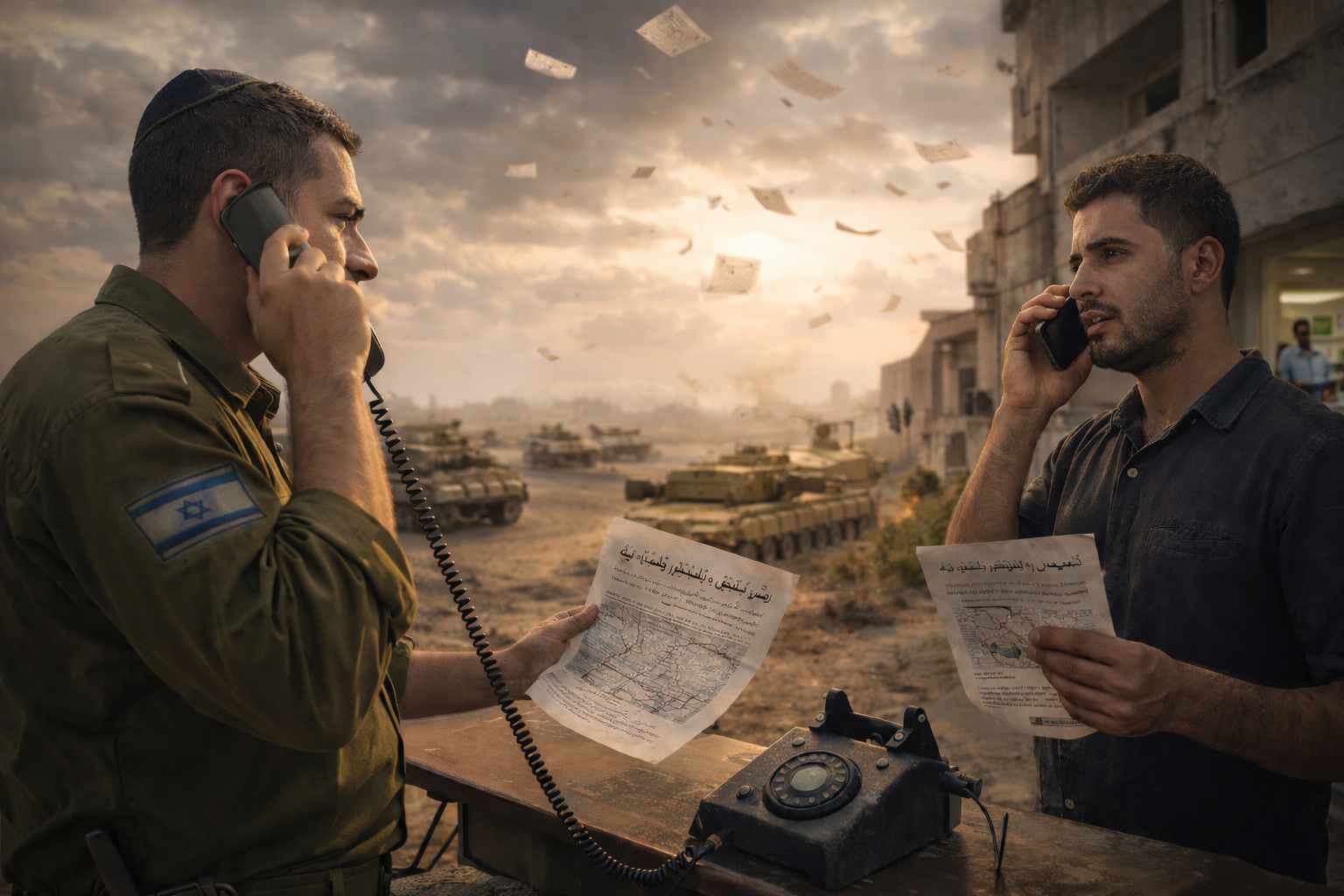
Before many strikes, Arabic-speaking officers from the IDF contact civilians in danger zones. They call phones. They send text messages. They speak fluent Arabic to people they have never met and say something remarkable.
“Please leave the building. It will be targeted.”
Leaflets are also dropped over neighbourhoods by the thousands. Millions over the course of conflicts. All written in Arabic. All carrying the same message.
Leave the area. We are about to strike a military target.
Think about that for a moment. In the middle of a war, one side is warning the population living near its enemy’s infrastructure to move to safety. Not because those civilians are its own citizens. But because they are human beings.
A Phone Call in Gaza
One particularly striking story involved a dentist living in Gaza. He received an anonymous phone call from someone speaking fluent Arabic. The caller calmly explained that a Hamas weapons tunnel ran beneath his building. The IDF was going to destroy it. He was asked to evacuate the building immediately. Not just his own family. His neighbours as well.
The dentist stayed on the phone with the officer as he went door to door, clearing the building. At one point, he explained that an elderly neighbour could barely move.
The strike was delayed so she could be helped out safely. When everyone was finally clear, the building was destroyed and the tunnel beneath it collapsed.
During the evacuation the dentist’s phone battery died. Moments later the officer called another mobile phone belonging to someone standing beside him. That is the level of intelligence and surveillance Israel possesses. And yet it was used not simply to strike.
But to avoid killing civilians first.
The Irony No One Mentions
This is the strange irony of the accusations Israel faces.
The same country accused of indiscriminate destruction invests extraordinary effort trying to prevent it. Warnings. Evacuations. Delayed strikes. Precision targeting.
All of this consumes time, intelligence resources and operational risk. Because every warning also risks allowing the intended terrorist target to escape.
But the alternative would be easier. Much easier. And far uglier.
The Question No One Seems to Ask
There is another uncomfortable question that rarely appears in these conversations.
If Israel really is the genocidal, land-grabbing monster it is constantly accused of being… why is Israel still so small?
Look at the map. Israel is a tiny sliver of land roughly the size of New Jersey. Surrounded by countries vastly larger in geography and population.
If Israel truly sought conquest or extermination, the reality of the region would look very different. Israel possesses the military capability to devastate its enemies. Everyone knows this.
So ask the obvious question. What exactly is stopping Israel from conquering half the Middle East?
The answer is simple. Israel has never wanted to.
The Land Israel Gave Away
The historical record is rarely mentioned.
In 2005 Israel withdrew completely from Gaza. Every soldier. Every civilian. Entire communities were dismantled. Jewish families were forced to leave homes they had lived in for decades. Synagogues were abandoned. Hotels, farms, factories and greenhouses were left behind in the hope they would form the foundation of Gaza’s future economy. Even Jewish graves had to be exhumed and moved. In Judaism, disturbing the dead is considered a profound violation, yet it was done to avoid leaving Jewish cemeteries behind.
All of this was done for one reason. Peace.
Earlier negotiations proposed handing over more than ninety percent of Judea and Samaria as part of a Palestinian state.
Again, the principle was the same. Land for peace.
For decades, Israel has demonstrated a willingness to exchange territory captured in defensive wars for the possibility of coexistence.
The Result
And what did those concessions bring? Peace? Calm? Serenity? Not quite.
Instead, Israel has had to invest ever more heavily in defence. Iron Dome intercepting rockets. Border barriers prevent infiltration. Advanced intelligence networks.
A powerful military designed for one purpose.
Survival.
Because when Israel withdraws, the vacuum is too often filled not by peaceful neighbours but by armed groups committed to its destruction.
The Hard Truth About War
After 7th October many Israelis would argue they would be justified in unleashing unrestrained hell on those responsible. War is hell. No one truly wins.
Even the victor must live with the burden of innocent lives lost and the constant judgment of distant commentators and keyboard generals observing from comfortable living rooms thousands of miles away.
And yet even after one of the worst massacres in Jewish history, Israel still operates within rules, legal oversight and moral debate that most of its critics rarely acknowledge.
The Hospital Doors
Even during periods of conflict, Israeli hospitals have treated thousands of Palestinian patients from Gaza. Children. Cancer patients. Critical care cases.
Sometimes, because Gaza’s own hospitals cannot treat them. Sometimes, because those hospitals have been taken over by militant groups.
The irony is almost impossible to ignore.
Yahya Sinwar, the architect of the 7th October massacre, once had his life saved by Israeli doctors while imprisoned in Israel. He was suffering from cancer. Israeli doctors treated him. They saved his life.
Years later, he would orchestrate one of the most brutal attacks on Jewish civilians in modern history.
Israel treated him anyway. Because doctors treat patients. Even enemies.
The Real Measure of Strength
Israel’s military strength is real. It has to be.
A country the size of a postage stamp surrounded by hostile actors does not survive long without the ability to defend itself.
But strength alone is not the story. The real story is how that strength is used.
Or more accurately… how often it is deliberately restrained.
In a region where brutality has too often been the norm, Israel has spent decades attempting something extraordinarily difficult:
To fight wars while still holding on to its humanity. It does not always succeed perfectly. No army in history ever has. But the effort itself matters.
Because the real measure of power is not what you can do. It is what you choose not to do.
Discover more from Tribe 613
Subscribe to get the latest posts sent to your email.
No responses yet