
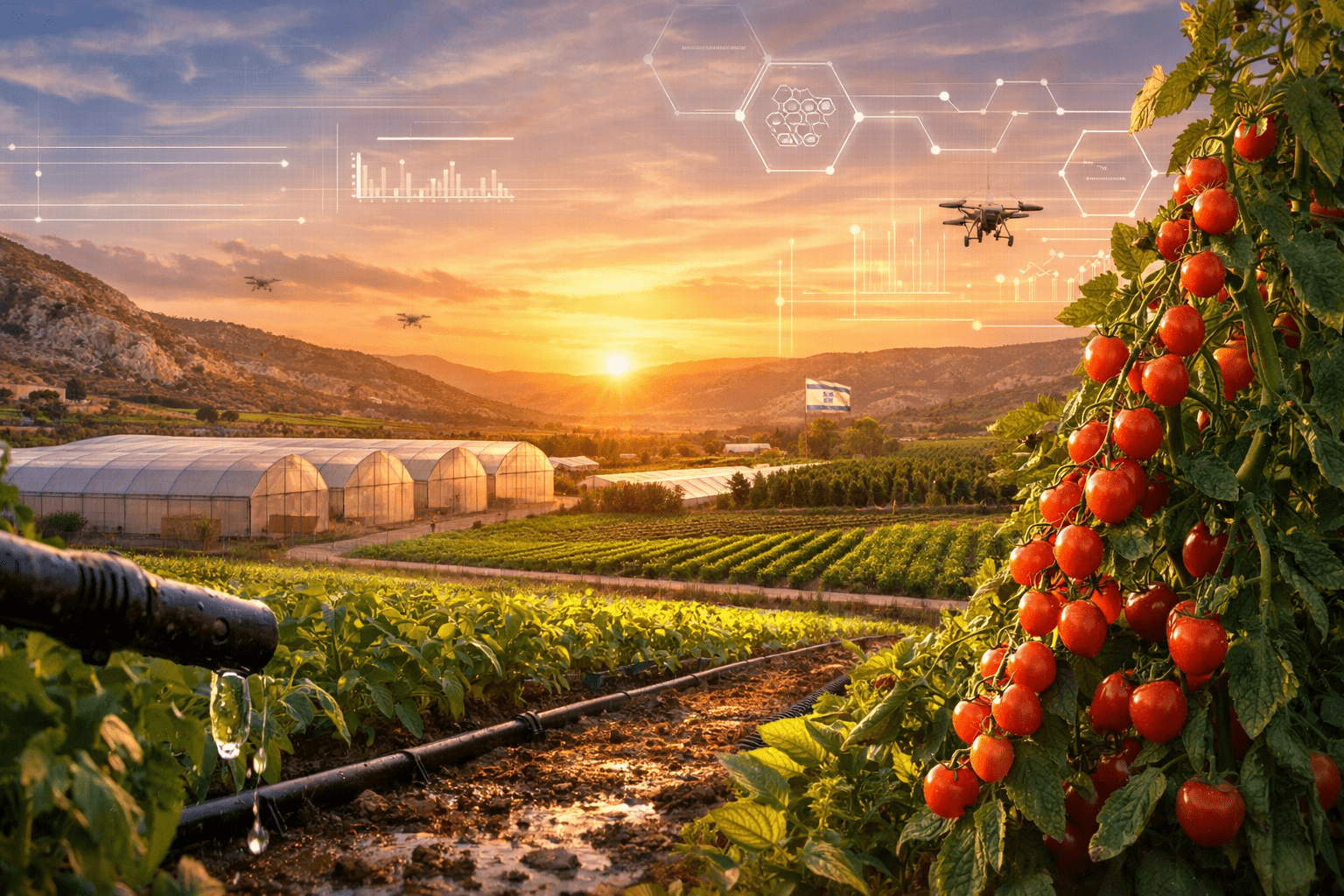
Stand on a hill in the Galilee or the Judean foothills and look out across the fields. You’ll see vineyards climbing rocky slopes, orchards bursting with citrus, greenhouses glowing in the sun, and rows of vegetables growing in soil that, not long ago, many people considered unusable.
A century ago, much of the land was either desert or mosquito-infested swamp. Malaria was common. Water was scarce. Farming was difficult.
Today, Israel is one of the most innovative food ecosystems on Earth.
Not bad for a country you could drive across in a few hours.
Turning Scarcity into Innovation
Israel never had the luxury of abundant land or water. That limitation forced creativity.
Instead of asking “How do we farm like everyone else?” Israelis asked a different question:
“How do we grow more food with less of everything?”
That mindset produced some of the most important agricultural innovations of the modern world.
Take drip irrigation, pioneered by the Israeli company Netafim. Instead of flooding fields with water, drip irrigation delivers tiny, precise drops directly to a plant’s roots. It saves enormous amounts of water and dramatically increases crop yields. Today, drip irrigation is used across the globe, from California vineyards to Indian rice fields. An idea born in a water-scarce country now feeds millions.
The Cherry Tomato That Conquered the World
Another quiet revolution happened in Israeli greenhouses.
Researchers at the Volcani Center developed modern varieties of cherry tomatoes that were sweeter, longer-lasting, and better suited to shipping and storage.
Today they’re everywhere. Salads, lunch boxes, restaurant plates. Tiny red ambassadors of Israeli agricultural science.
Citrus, Orchards, and Reinventing the Land
The agricultural revival of Israel also produced some iconic crops.
The Jaffa orange became famous worldwide. Citrus groves flourished along the coastal plain. Farmers cultivated pomelo, pomegranates, olives, bananas, dates, almonds, pistachios, herbs, and countless other crops.
Each required experimentation with soil, water, and climate.
In a place where rain falls only part of the year and summers are blisteringly hot, farming demanded ingenuity.
So Israel turned agriculture into science.
Where Food Meets Technology
Fast forward to today and Israel isn’t just growing food. It’s reinventing how food is made.
Companies like Strauss Group have invested heavily in food technology incubators, supporting startups developing everything from precision fermentation to alternative proteins and smart nutrition.
Tel Aviv and Haifa have become hubs for FoodTech, where chefs, scientists, engineers, and entrepreneurs collide.
The result? Hundreds of startups exploring:
- Plant-based and cultivated proteins
- fermentation-driven ingredients
- AI-powered agriculture
- vertical farming
- smart food manufacturing
- sustainable packaging
Israel now hosts one of the largest concentrations of food-tech startups in the world.
A Culture Built on Food
Of course, innovation alone doesn’t explain it.
Food is deeply woven into Israeli life. Shabbat tables piled high with salads. Markets bursting with herbs and spices. Street corners serving hummus, falafel, and shawarma. Grandparents proudly and fiercly guarding their family recipes from Morocco, Iraq, Poland, Yemen, Ethiopia and beyond.
Israel’s cuisine is essentially a living map of the Jewish diaspora, mixed with Middle Eastern and Mediterranean traditions.
When so many cultures meet around the same kitchen table, creativity is inevitable.
Global Impact
Israel’s impact doesn’t stop at its borders. A huge portion of Israeli agricultural innovation was designed from the beginning to be shared with the world. Today, Israeli agri- and food-tech solutions are used in well over 100 countries, helping farmers grow more food with fewer resources. Technologies pioneered by companies like Netafim and developed through research institutions such as the Volcani Center are now used across India, China, the United States, Brazil, Mexico, Spain, Australia and much of Africa.
Drip irrigation alone — an Israeli invention born from the challenge of farming with very little water — now irrigates tens of millions of acres of farmland worldwide. Some estimates suggest that around half of the world’s drip-irrigated land uses Israeli technology or systems derived from it. In countries where water scarcity threatens food security, these innovations are helping farmers increase yields while using dramatically less water.
In other words, innovations developed in a country that makes up just 0.001% of the world’s landmass are quietly helping feed millions of people across the planet.
Tiny Country. Giant Appetite for Innovation.
Israel represents about 0.001% of the world’s landmass.
Yet in fields like agriculture, water technology and food innovation, it punches dramatically above its weight.
A place once dismissed as barren has become a laboratory for feeding the future. From drip irrigation to cherry tomatoes. From desert farms to global food tech startups.
It turns out that when necessity meets imagination, even a tiny patch of land can help nourish the world.
And honestly? That’s a very Israeli recipe.
Discover more from Tribe 613
Subscribe to get the latest posts sent to your email.
No responses yet