
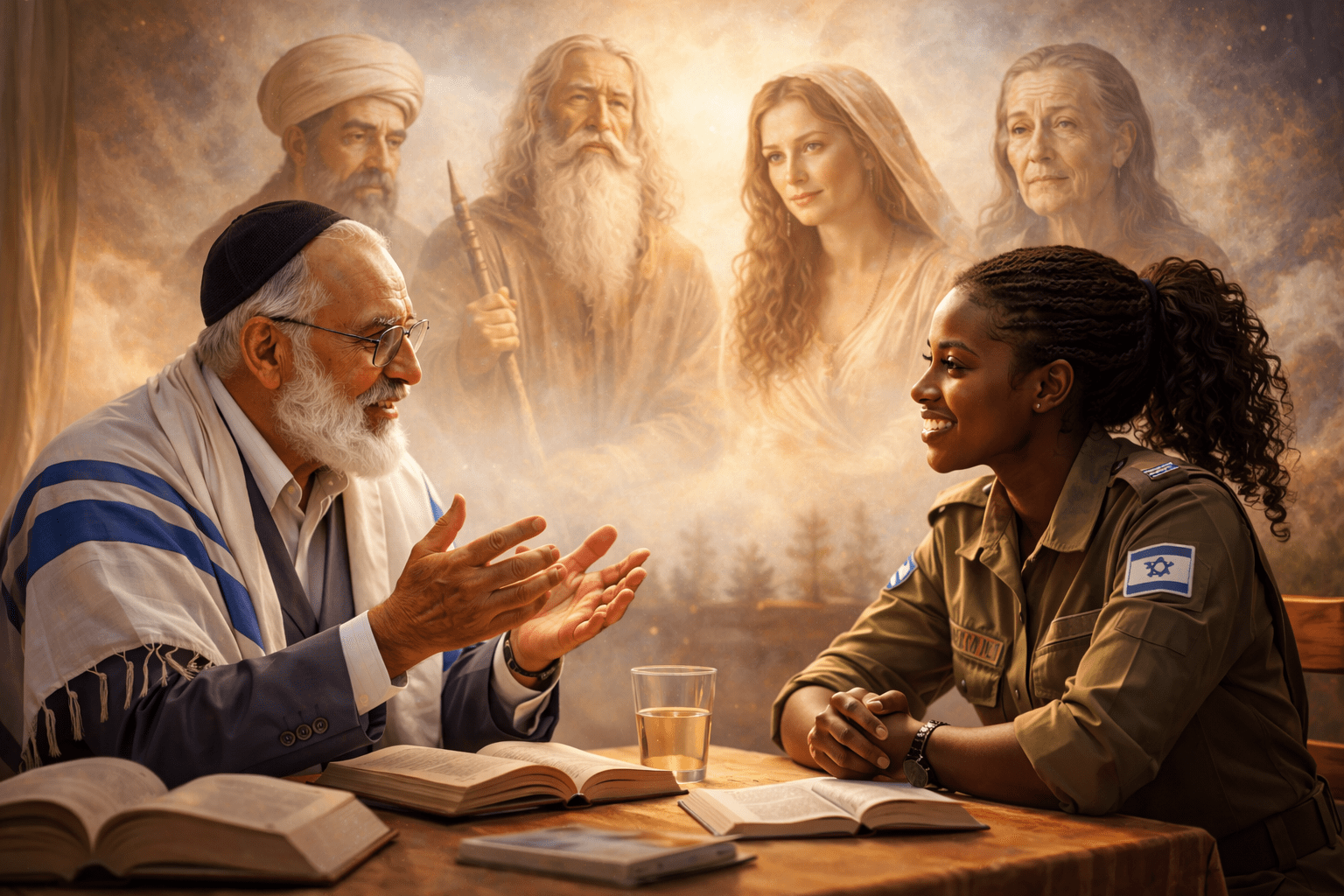
Spend enough time around Jews and you’ll quickly notice something remarkable.
We might be one people, but we are certainly not one type of people.
Judaism is not a single shade. It is a spectrum.
There are United Synagogue Jews, Reform Jews, Liberal Jews, Orthodox Jews, Modern Orthodox Jews, Chassidic Jews, Haredi Jews, and Jews who don’t set foot in a synagogue at all. There are Ashkenazi Jews whose families came from Europe, Sephardi Jews whose traditions grew in Spain and North Africa, Mizrahi Jews whose roots stretch across the Middle East, and communities from Ethiopia, India, China and beyond.
We are black, brown, olive, pale, and every shade in between.
Some Jews keep Shabbat strictly. Some drive to synagogue. Some light candles once a year. Some don’t light them at all. Some believe deeply that prayer is what sustains us. Others believe just as deeply that strength, resilience and the ability to defend ourselves is what protects us.
Many of us sit somewhere in between.
There’s an old Jewish joke that captures this perfectly: Put two Jews in a room and you’ll get three opinions.
It’s funny because it’s true.
Debate is part of our DNA. It always has been. The Talmud itself is essentially thousands of pages of rabbis arguing with each other across centuries.
And yet, despite all of those differences, there is a thread running through every one of us.
A thread that stretches back thousands of years.
A thread that connects us to the same ancient story.
Am Yisrael. The people of Israel.
The Family Argument
Like any large family, Jews argue.
Sometimes loudly.Sometimes stubbornly. Sometimes in ways that make you wonder whether we remember that we are actually on the same side.
There is judgement within our own community. Accusations that someone is “not religious enough.”
Or on the other side, that someone is too religious. Too traditional. Too secular. Too Zionist. Not Zionist enough.
But Judaism has never been one uniform mould.
It has always been a civilisation carried by many different communities, cultures and interpretations.
From the academies of Babylon to the streets of Jerusalem.
From the shtetls of Eastern Europe to the synagogues of Morocco.
From Ethiopian villages to modern Tel Aviv.
Different customs. Different accents. Different ways of living Jewish life. But still part of the same story.
Because the truth is simple: Judaism has never required us to think the same.
It has only required us to remember we are the same people.
The Hard Conversations
Sometimes the differences become more than cultural. They become political. Emotional. And deeply painful.
Take the ongoing debate in Israel about the military draft for the Haredi community.
For decades, ultra-Orthodox men have largely been exempt from IDF service so they can dedicate themselves to studying Torah. Many believe that their prayers and learning provide a spiritual protection for the Jewish people.
But in a country where young men and women from other communities (including Muslims, Druze, Christians and many more) risk their lives defending the state, that exemption has become increasingly controversial.
It is not surprising that tensions erupt when some Israelis feel they are being asked to fight and sometimes die to protect a country that others are not required to defend physically.
At the same time, many Haredim genuinely believe that forcing them into the army threatens their way of life and religious identity.
Both sides believe they are protecting the Jewish future.
But when those disagreements spill into riots in the streets of Jerusalem, accusations, and bitterness, something deeper is revealed.
A family argument that has started to forget it is a family.
The Fringe on Every Edge
Every community has its fringes.
There are ultra-religious extremists who speak about non-Jews with hatred and contempt, and sometimes even direct that hostility toward other Jews who do not live the way they believe is correct.
That kind of thinking is not strength.
It is not Judaism at its best.
And it is dangerously close to the same kind of blind hatred that has been directed at Jews throughout history.
When even a small minority behaves this way, it becomes ammunition for those who wish to demonise the entire Jewish people.
It is one of the reasons the word “Zionist”, which simply means believing that the Jewish people have a right to live safely in their ancestral homeland, has been twisted into something toxic in the mouths of our critics.
The overwhelming majority of Jews who identify as Zionists do so because they believe in safety, self-determination and survival.
Not supremacy. Not hatred. Not domination.
Just the right of a people, like any other people, to exist.
A Moment of Reckoning
Sometimes it feels as if we are living through a kind of Tower of Babel moment.
The noise grows louder. The arguments multiply. Communities pull in different directions until we stop hearing one another at all.
At other times it feels closer to the warning stories of Sodom and Gomorrah – not because we are doomed, but because those stories remind us what happens when a society loses its moral centre and forgets its responsibility to one another.
Jewish history is full of moments like this. Moments when we drifted apart. Moments when internal division weakened us.
But Jewish history is also full of something else.
Moments when we remembered who we were. Because when Jews stand together as Am Yisrael, something extraordinary happens. We become almost impossible to break.
Empires have risen and fallen around us. Civilisations that once tried to erase us from history no longer exist.
And yet we are still here.
Not because we were always stronger than our enemies.
But because, when it truly mattered, we remembered that we were stronger together.
When the Light Fractures
Jewish mysticism offers a powerful metaphor for moments like this.
In Kabbalah there is a concept called Shevirat HaKelim – the shattering of the vessels.
The divine light was too powerful for the vessels meant to contain it and they shattered, scattering sparks everywhere.
The task of humanity is Tikkun Olam – repairing the world – by gathering those sparks and restoring wholeness.
Sometimes it feels as if the Jewish people themselves are experiencing something similar.
Pieces of light scattered in different directions. Different communities. Different beliefs. Different identities. Each holding part of something ancient and powerful.
But forgetting that those pieces were once part of the same light.
A Call to Remember
Teshuvah is usually translated as repentance. But its deeper meaning is return.
Perhaps what we need today is a kind of collective teshuvah. Not necessarily a return to the same level of religious observance. Not a demand that everyone believe the same things. But a return to something deeper.
A return to each other.
If you’re reading this, perhaps the simplest place to begin is with a small act.
Reach out to another Jew. Someone who looks different from you. Prays differently from you. Votes differently from you. Or perhaps believes very different things from you.
Speak. Listen. Build a bridge.
Remember that we are part of the same ancient tribe.
A people who have survived exile, persecution, dispersion and countless attempts to erase us from history. A people who remained undefeated not because we were identical – but because we were united.
Our diversity does not have to divide us. In fact, it may be our greatest strength.
Because when the many voices, cultures and traditions of the Jewish world stand together, they form something far more powerful than uniformity ever could.
They form Am Yisrael.
And if we remember that again – truly remember it – then our differences will not break us. They will strengthen us. The scattered sparks will begin to gather.
And once again we will shine as one people.
Discover more from Tribe 613
Subscribe to get the latest posts sent to your email.
Comments are closed