
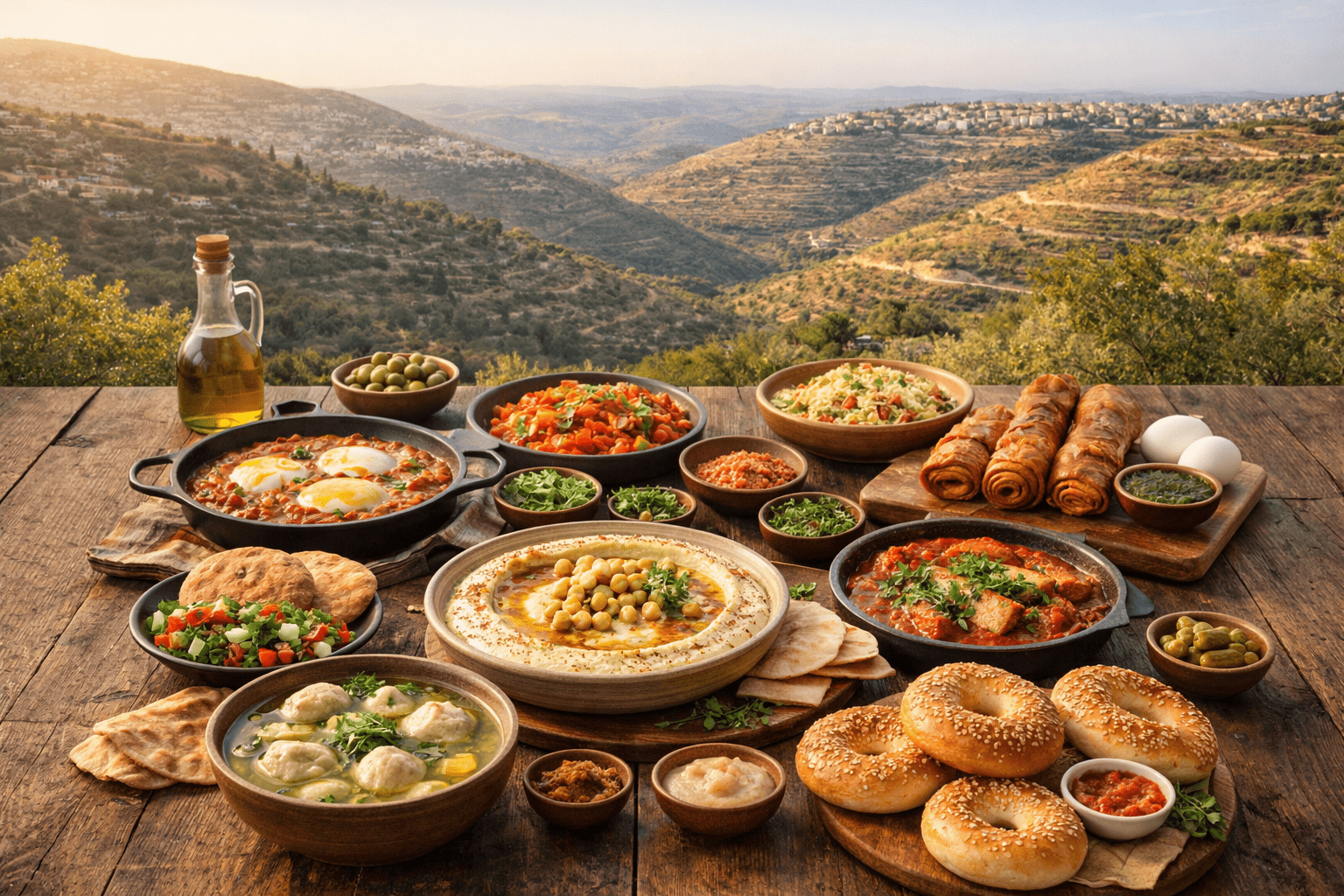
Jewish food doesn’t come from one place. It comes from everywhere.
It’s a passport stamped in spice. A suitcase packed in flour. A story told in simmering pots and shared tables. Wherever Jewish people went, they carried three things: our values, our stories… and our recipes. And those recipes didn’t just survive. They absorbed. They adapted. They evolved.
The result? A cuisine that stretches from the smoky markets of Yemen to the snow-dusted bakeries of Poland, from Moroccan spice stalls to the sun-soaked kitchens of Tel Aviv.
And for me… it starts much closer to home. Before any of this became a story, it was the amazing aromas drifting out of my grandmother’s kitchens. Those amazing ladies were my culinary heroes.
Not chefs in the formal sense. No written recipes. No measurements. Just instinct, memory and an unspoken confidence that somehow everything would come together exactly as it should.
I learned by watching their hands. By noticing when to stir, when to wait, when to taste and when to trust. By understanding that food wasn’t just made… it was felt. And those early memories still sit with me today:

Locshen soup with kenidlach – soft dumplings floating like clouds in golden broth.
Marak Temani, deep, earthy and spiced, like the kitchen itself had found a heartbeat.


Falafel, crackling hot in hot oil, impossible to ignore. Crispy on the outside. Soft an moist on the inside. Mouth-sized bites of pure heaven.
And then… zhug.
Let’s be clear. Zhug is not a condiment. Zhug is a (big) personality in its own right. It doesn’t knock politely. It kicks the door in, looks around and says, “Nuuh! We’re doing this now.”
And somehow, you’re very glad it did.

That was my introduction to Jewish food. Not as a concept. As a feeling. Chaotic. Eclectic. A mixed bag of everything from all corners of the world. Much like Israel itself.
So let’s take a journey around the world… one unforgettable dish at a time.
🇮🇱 Israel: Where Everything Comes Together

In Israel, hummus isn’t a side dish. It’s the centre of gravity. It’s practically a religious experience.
Chickpeas, tahina, lemon, garlic… that’s the list. And yet, when it’s done right, it becomes something far greater than the sum of its parts.
Warm or cold, impossibly smooth, finished with olive oil pooling on top like a sea of liquid gold.
You don’t eat hummus alone. You share it. You tear bread, scoop generously and somehow everyone ends up leaning in a little closer to the table.
Core ingredients: Chickpeas, tahina, lemon juice, garlic, olive oil
Flavour profile: Creamy, nutty, bright, quietly addictive
Why it matters: Israel is where Jewish food from across the world comes together. Not neatly, not perfectly… but beautifully. Hummus is the great unifier. No hierarchy, no fuss. Just food doing what it’s meant to do. Making you feel happy inside and out.

Shakshuka doesn’t arrive quietly. It bubbles. It hisses. It announces itself from the kitchen before you’ve even sat down.
A pan of tomatoes and peppers, slow-cooked into something rich and deep, spiced with garlic, cumin and paprika… and then, right at the last moment, eggs cracked gently into the sauce, poaching in place like they’ve found their home.
But shakshuka isn’t just a dish. It’s a moment.
The kind where everyone leans in. Bread already torn, ready to scoop. No waiting for plates. No ceremony. Just instinct. And like so much of Jewish food, it didn’t start in one place. It travelled. North Africa to Israel. Carried, adapted, reimagined.
Now? You’ll find it everywhere. Café menus. Brunch spots. Kitchens across the world. And yet… when it’s done right, it still feels like it belongs exactly where it is.
Core ingredients: Tomatoes, peppers, garlic, olive oil, cumin, paprika, eggs (or, in my kitchen now, gently spiced tofu)
Flavour profile: Rich, warming, slightly smoky, with a depth that builds and lingers
Why it matters: Shakshuka is Jewish food in motion. Always evolving. Always adapting. Never losing its soul. It doesn’t ask for perfection. It invites participation. And somehow, every time, it brings people back to the table.
🇾🇪 Yemen: Fire, Bread and Soul

Jachnun is patience, rewarded. A slow-baked pastry, cooked overnight until it turns deep golden, almost caramelised. Rich, soft, indulgent.
And then you add zhug. That same green, fiery, herby explosion that refuses to be ignored. The kind of heat that doesn’t overwhelm… it wakes everything up. And a little bite of hard-boiled egg for that extra textural and flavour kick.
Core ingredients: Flour, butter, tomatoes, eggs (traditionally), zhug (chilli, garlic, coriander, spices)
Flavour profile: Buttery, slightly sweet pastry balanced by sharp heat and fresh herb intensity
Why it matters: Yemenite Jewish food doesn’t whisper. It speaks clearly, boldly, with depth and confidence. It brings energy to the table.
🇲🇦 Morocco: Where Spice Tells Stories

Chraime doesn’t arrive quietly. Fish simmered in a thick tomato sauce layered with garlic, paprika, cumin and chilli. The kind of dish that fills a home with aroma before it even reaches the table.
You don’t need to announce dinner. Chraime does that for you.
Core ingredients: White fish, tomatoes, garlic, paprika, cumin, chilli, olive oil
Flavour profile: Deep, warming, spiced with just enough heat to keep you coming back
Why it matters: Moroccan Jewish food is generosity made visible. Big flavours, bold colours, dishes designed to be shared and remembered.
🇵🇱🇱🇹 Eastern Europe: Resilience, Reinvented

The bagel started as necessity. Boiled, then baked. Dense, chewy, practical. Built to sustain people through cold climates and difficult times. And then, somehow… it travelled.
Now you’ll find it everywhere across the world, filled, toasted, reimagined endlessly.
Core ingredients: Flour, yeast, water, salt
Flavour profile: Chewy, slightly sweet, endlessly versatile
Why it matters: The bagel is one of Jewish food’s quiet triumphs. A simple idea that crossed continents and became global.
Before “comfort food” became a phrase, there was lokshen soup.
A golden broth, slow-simmered, carrying the quiet wisdom of time. Fine noodles drifting through it like threads and keneidlach – soft, pillowy dumplings – sitting gently on top like they’ve always belonged there.
This isn’t just soup. This is the soup. The one that appears when you’re unwell. The one that’s waiting when you come home. The one that somehow knows exactly what you need, even when you don’t.
Core ingredients: Clear chicken broth (or rich vegetable broth in my kitchen now), carrots, celery, onion, herbs, lokshen noodles, keneidlach
Flavour profile: Light yet deeply comforting, clean, warming, restorative
Why it matters: Lokshen soup is the root of something much bigger than itself. It’s where the idea of “Jewish penicillin” was born.
It’s the origin of what the world now calls chicken soup for the soul. Because this dish was never just about nourishment. It was about care.
🌍 And Then… Everything In Between
Some dishes don’t stay where they started.
Bourekas: flaky, golden parcels that quietly disappear from plates everywhere.
Latkes: crisp, comforting, impossible to eat just one.
Baba ganoush: often overlooked, but this smoky, silky, quieter cousin of hummus rewards those who pay attention.


Each one carries a story. A journey. A memory. And a world of flavours.
Evolving the Table
Today, I’m fully plant-based. But that hasn’t taken me away from these dishes. If anything, it’s brought me closer. Because our cuisine was never fixed or set in stone.
It has always been about adapting. Taking what’s available and making something meaningful from it. So those same flavours still live on in my kitchen, just reimagined:
Keneidlach without eggs, still soft, still comforting.
Slow-cooked stews built on vegetables, legumes and spice that lose nothing in depth.
Shakshuka… the same but different. Diced tofu replaces the poached eggs.
Hummus, falafel, sabich… already plant-based and quietly leading the way.
Nothing is lost. Something new is created. And in many ways, that feels exactly right. Because that’s what my grandmothers were doing all along.
The Final Bite
Jewish food isn’t just about flavour. It’s about memory. Adaptation. Identity. Soul.
A people who travelled the world… picked up flavours along the way… and somehow brought it all back to one table.
And that table? It looks a lot like us. Mixed. Layered. Sometimes a little chaotic. Always vibrant. Different textures, different origins, different stories… somehow sitting side by side in perfect, beautiful balance.
Just like Eretz Yisrael itself.
A land built from gathering. From return. From voices, traditions and cultures that don’t erase each other… but enrich one another.
That’s why I’m so proud of who we are. Because our food tells the same story our people do: Resilient. Diverse. Creative. Alive. And definitely a little bit special.
And maybe that’s why food is the perfect metaphor for Am Yisrael. Because when it’s done right, nothing is lost. Everything is brought in, given its place and turned into something all the better for the different flavours and tastes.
So pull up a chair. Grab a plate. And dive in… Bon Apetite – Bete’avon – בתיאבון
Discover more from Tribe 613
Subscribe to get the latest posts sent to your email.
Comments are closed