
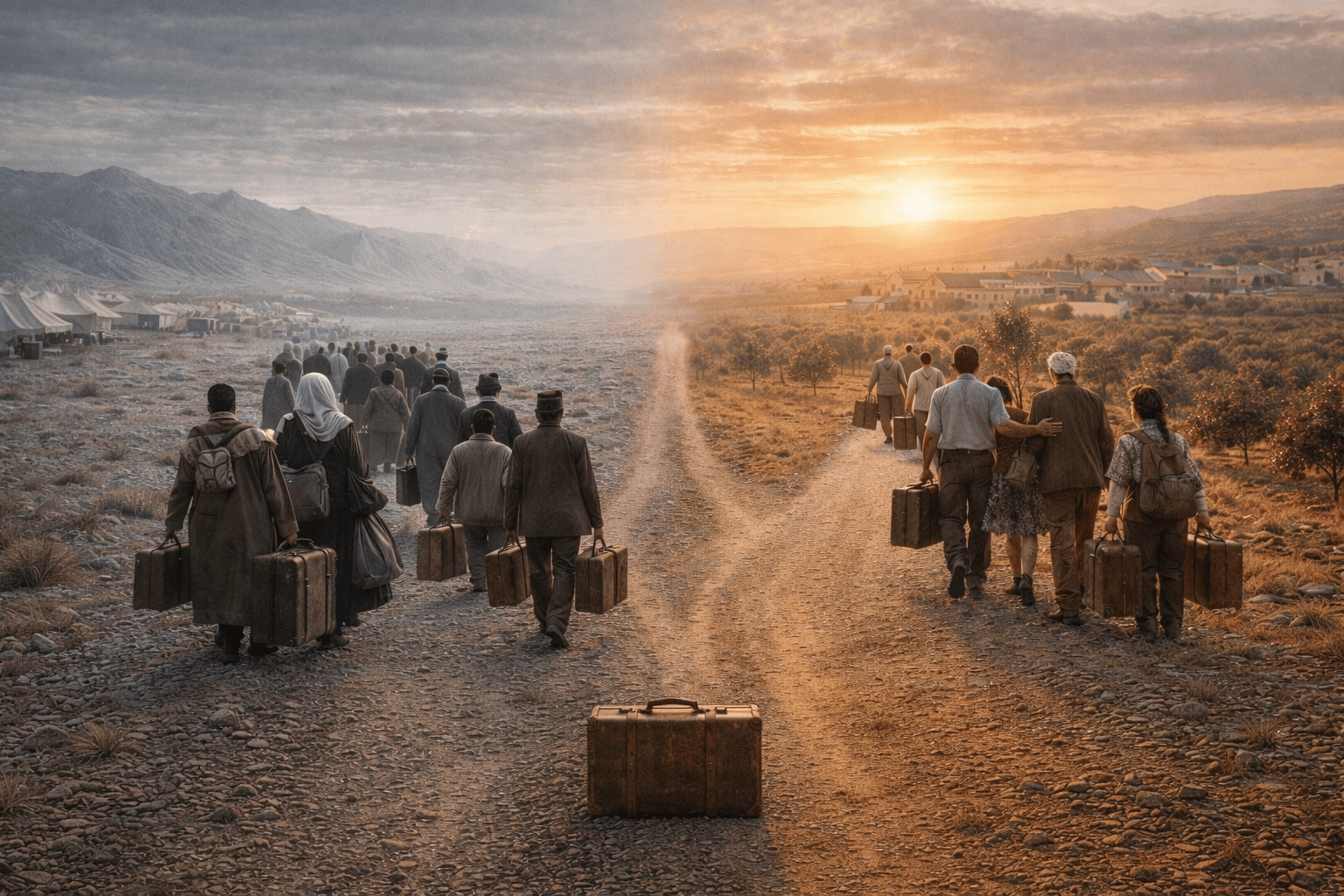
The world has learned one word. Nakba.
It is spoken with certainty. Repeated like scripture. Framed as if only one people suffered, only one people lost homes, only one people became refugees and only one story matters.
But history is not a slogan. And this history, in particular, has been flattened until it barely resembles reality.
So let’s bring the missing half back into the light.
Because yes, there was displacement in 1948. Yes, there was fear. Yes, there was loss. Yes, many Arabs left.
But why they left, what happened next and what happened elsewhere at exactly the same time… that is where the story fractures.
Many Arabs were told to leave by their own leaders. Promised a swift victory. Promised that the Jews would be wiped out, erased, pushed into the sea. “Leave now,” they were told. “Return later. The land will be yours.”
That promise collapsed.
And the people who left were not just victims of war. They were victims of a catastrophic lie.
But here is the part that almost never gets told.
While the world fixates on one refugee story, it ignores another, larger one unfolding in parallel.
Over 800,000 Jews were forced out of Arab lands.
Ancient communities. Iraq. Yemen. Egypt. Syria. Libya. Lebanon. Morocco. Places where Jews had lived for centuries, sometimes millennia. Long before modern politics. Long before 1948.
They were stripped of citizenship. Their homes seized. Their businesses stolen. Their synagogues burned. Their lives uprooted.
They didn’t leave because they wanted a better opportunity. They left because they were no longer safe to exist as Jews. And where did they go? They came to Israel.
A tiny, newborn state. Poor. Under attack. Surrounded. Outnumbered. Fighting for its life.
And what did Israel do? It absorbed them. Not reluctantly. Not temporarily. Not as a political tool. It brought them home.
Through aliyah, Jews came from everywhere. From Europe’s ashes. From Arab lands. From anywhere they could escape. And when escape wasn’t possible, Israel didn’t wait.
It went out and rescued them.
Operation Magic Carpet flew entire communities of Yemenite Jews to safety. Operation Moses carried Ethiopian Jews out of famine and danger, across deserts and into a future.
Planes instead of promises. Rescue instead of rhetoric. Citizenship instead of camps.
Israel took refugees and made them part of the nation.
Now look at the other side of that same moment in history.
The Arabs who left during the war… where did they go? To neighbouring Arab countries. Jordan. Egypt. Syria. Lebanon.
Places with shared language. Shared culture. Shared religion. Shared identity. Shared history.
And what happened?
They were not absorbed. They were not integrated. They were not given citizenship in most cases. They were left in camps. Left stateless. Left in a kind of permanent waiting room of history. Refugees in lands that called themselves their brothers.
Generation after generation, that status remained. Not resolved. Not healed. Not integrated. Preserved.
Because a solved refugee crisis doesn’t serve a political narrative.
But an unresolved one? That can last forever.
So a question hangs in the air, uncomfortable and rarely asked: Did those refugees turn to their leaders and ask why they were told to leave? Did they demand accountability from the governments that promised victory and delivered exile?
No.
They were taught to blame the Jews. To blame Israel. To blame the very people who, at that same moment in history, were absorbing refugees instead of storing them.
And from that… something far more dangerous than displacement was born.
A multi-generational inheritance of grievance.
Not just loss of land, but a cultivated identity built around that loss, passed down like an heirloom. Refined. Repeated. Reinforced.
Not resolved. Because resolution requires truth.
And truth complicates the story.
The Jews did not invade their homeland. We did not colonise the land that gave birth to our people, our language, our faith.
We returned. We decolonised a land that had passed through empires but never lost its original story.
We purchased land legally. We rebuilt communities. We revived Hebrew. We drained swamps and planted forests. We built something where very little existed before.
And we did it while absorbing wave after wave of refugees who had nowhere else to go.
And here’s the part that breaks the neat narrative entirely: Not all Arabs left. Many stayed. Willingly.
And those who stayed became part of the country. They built lives. They raised families. They contributed culture, language, food, music, identity. They didn’t disappear. They became part of the story. The live, danced, laughed, lives and even fought alongside us. As brothers and sisters.
Which means the story cannot be what it is so often claimed to be. Because reality is messier. More human. More uncomfortable.
So yes, there was a Nakba. But there was also a Nachbah.
A catastrophe for Jews across the Arab world. A mass displacement. A forced exile.
A story almost entirely erased from global conversation.
The difference is what happened next.
One group was kept as refugees. The other became citizens.
One group was left in limbo. The other built a future.
One story was amplified. The other was buried.
And that imbalance has shaped everything that followed.
So when people speak about 1948 as if it were simple, as if it were one-sided, as if it were obvious who the villains and victims were… they are not describing history. They are repeating a script.
The truth is harder.
The truth is that 1948 was not just about Arabs who left.
It was about Jews who returned.
Jews who were expelled from elsewhere. Jews who were rescued. Jews who were absorbed. Jews who literally had nowhere left to go.
And yes, Arabs who stayed and became part of a shared, complicated, imperfect society.
That is Israel.
Not a colonial outpost. Not a foreign implant. Not a historical accident.
A rebuilding. And a story that cannot be understood honestly unless all of it is told.
Discover more from Tribe 613
Subscribe to get the latest posts sent to your email.
One response
[…] Arabs were displaced in large numbers in the war for Jewish statehood. The reason most left was because their leaders told them to leave so they could exterminate the Jews – leaving the land free for Arabs to take over. Most never returned. They lost because of a […]