
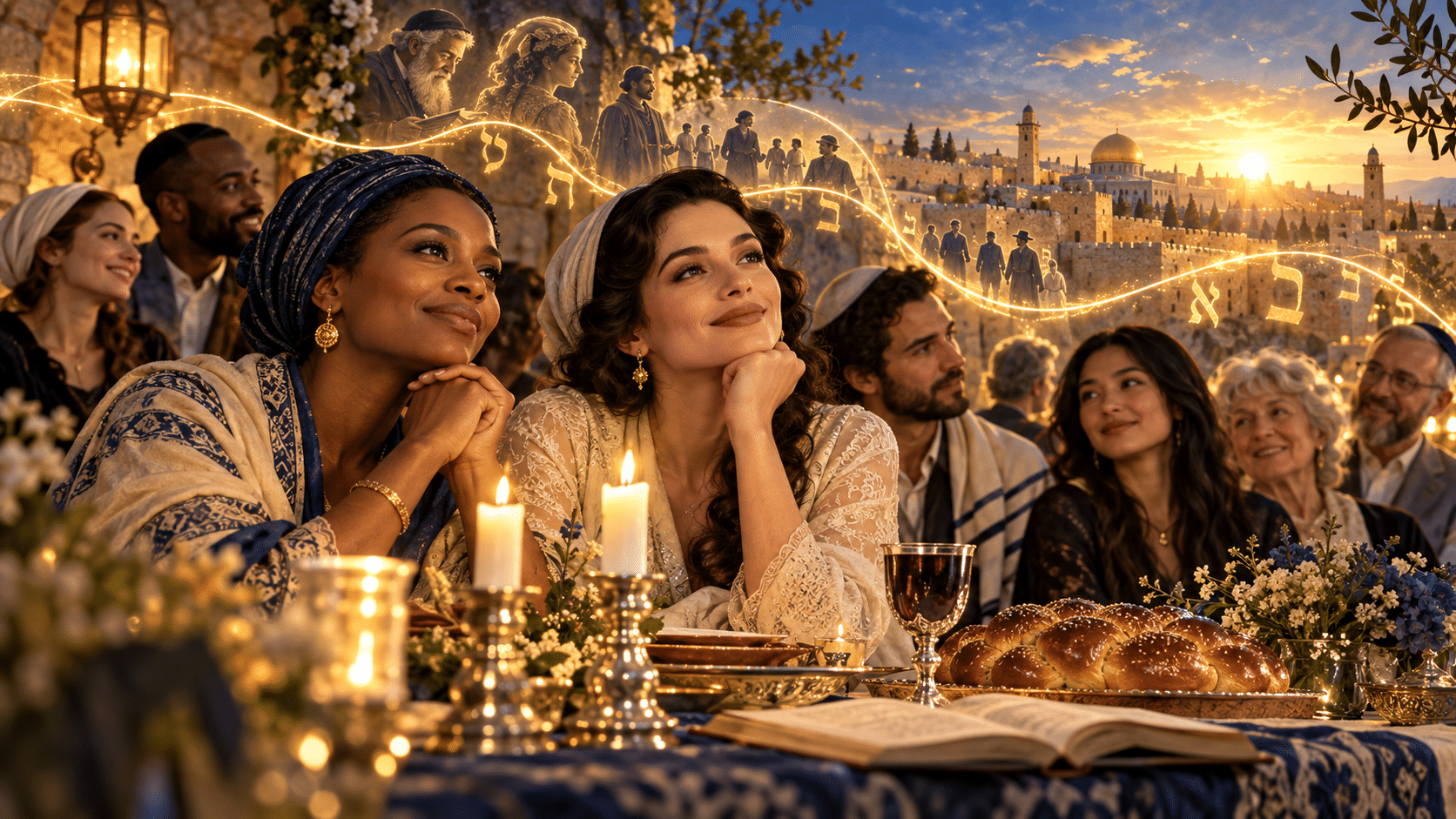
I learned something recently that genuinely stopped me in my tracks: Marilyn Monroe was Jewish.
Yes. That Marilyn Monroe.
Norma Jeane. Hollywood icon. Probably one of the most photographed, recognised and famous women who has ever lived. She chose Judaism.
And then I discovered that Elizabeth Taylor did too.
Two of the most famous, successful, powerful and culturally significant women of the twentieth century looked at this tiny, ancient, frequently persecuted tribe of ours and essentially said:
Your people are my people.
Just let that sink in for a moment.
Marilyn Monroe studied Judaism seriously with Rabbi Robert Goldburg before converting in 1956. She owned a siddur. She took notes in it. She went through a formal conversion and married Arthur Miller under a chuppah.
And importantly, after their marriage ended, she reportedly told her rabbi that she remained committed to being Jewish.
This wasn’t simply Marilyn Monroe changing religion on a marriage certificate.
She learned. She studied. She chose.
Then there was Elizabeth Taylor.
Elizabeth converted in 1959 after months of study. She later made it very clear that her decision was not simply because she had married Jewish men. She said it was something she had wanted for a long time.
After converting, she remained publicly connected to Jewish life and Israel for decades.
This was Elizabeth bloody Taylor. At the absolute summit of Hollywood.
She didn’t need another identity. She chose ours.
And once I started looking, I realised Marilyn and Elizabeth weren’t remotely alone.
Look at these extraordinary women
Ahuvah Gray grew up in a Baptist family in Chicago, became an ordained Christian minister and eventually found herself questioning the theology she had spent years teaching.
So she kept learning. And learning.
Eventually she moved to Israel, studied Judaism at Nishmat in Jerusalem, supported herself by cleaning homes and, at the age of 51, completed an Orthodox conversion.
Think about that journey; from Christian minister… to Jerusalem… to Jewish woman.
Not because somebody handed her an Ancestry result. Not because her grandmother made chicken soup. Not because she grew up hearing Dayenu every Pesach.
Because she went searching. And eventually decided: This is where I belong.
Then there’s Kate Capshaw, the American actress best known for Indiana Jones and the Temple of Doom, who later married Steven Spielberg.
When she converted, something extraordinary happened alongside her own journey.
Steven Spielberg later explained that he studied with her as she learned Judaism, and in doing so began rediscovering things he had forgotten.
I absolutely love that.
A woman joining the Jewish people helped a Jewish man rediscover his own Judaism.
There’s almost an entire article in that sentence alone.
Anne Buydens, wife of Kirk Douglas, went even further down the wonderfully unexpected road.
After 49 years of marriage, she decided, on her own, to convert. Forty-nine years!
This wasn’t exactly a panicked pre-wedding decision because the caterer had already ordered the kosher salmon. She had spent nearly half a century alongside a Jewish man and eventually decided that Judaism was where she belonged too.
Afterwards, Anne took over lighting the Shabbat candles that Kirk had lit during the first fifty years of their marriage.
How beautiful is that?
Then you have Ivanka Trump, who converted to Orthodox Judaism before marrying Jared Kushner.
Whatever anybody thinks of the Trump family politically is completely irrelevant to what I’m talking about here.
Her conversion involved serious study and she has spoken publicly about Judaism, kashrut and Shabbat becoming meaningful parts of her family life.
And interestingly, a few years later, Jared’s brother Joshua Kushner married Karlie Kloss, one of the most successful supermodels of her generation, who had also made the decision to convert to Judaism.
Karlie has described it not as some casual box-ticking exercise for marriage, but as a journey involving years of study, conversations, soul-searching and a decision she did not take lightly.
She has spoken particularly warmly about Shabbat and the meaning she found in deliberately stopping, disconnecting from the frantic world around her and reconnecting with what actually matters.
Which feels rather beautiful when you consider that her professional life existed in almost the exact opposite universe: fashion, cameras, travel, noise, visibility, phones and constant movement.
And yet she found meaning in: Stop. Friday night. Put it down. Come home.
Again, the story is hers. Not her husband’s. Not the Kushner family’s.
Hers.
Because ultimately Karlie had to make the decision herself.
Then there’s one of the most fascinating journeys of all: Nasrin Kadri.
Born into an Arab Muslim family in Israel, Nasrin became one of Israel’s best-known singers, performing in both Arabic and Ivrit.
She began studying Judaism and eventually completed a conversion process in 2018, taking the Hebrew name Bracha, meaning blessing.
Her conversion was performed through an independent rabbi and is not recognised by Israel’s Chief Rabbinate, which makes the religious-status question more complicated than a neat headline suggests.
But the personal journey remains extraordinary.
And centuries before any of them, there was Nahida Ruth Lazarus, a successful nineteenth-century German writer who began studying Judaism academically… and studied herself straight into it.
She published The Jewish Woman while still Christian. Then kept learning. And in 1894 she formally converted.
Imagine studying something so deeply that eventually you realise you’re no longer examining it from outside.
You’re home.
And it isn’t just women
Although, seriously, what a list of women.
There’s Sammy Davis Jr. Black. American. One of the greatest entertainers of his generation.
After nearly losing his life in a car accident, Sammy began reading deeply about Judaism.
He became fascinated by a question that feels particularly poignant coming from a Black American man living through segregation: How had this tiny people survived so much persecution for so long?
He studied with Rabbi Max Nussbaum and eventually formally converted. Years later, he explained that in Judaism he had found strength and dignity.
This wasn’t an eccentric celebrity phase. Friends eventually realised just how seriously Sammy took his Jewishness. He observed Yom Kippur even when Hollywood schedules made doing so inconvenient.
And remarkably, Sammy wasn’t the only person in that marriage who chose Judaism.
His wife, May Britt, was a Swedish actress who had become a Hollywood star in the 1950s. Before marrying Sammy in 1960, she converted to Judaism too.
Their marriage was already an extraordinarily bold decision in an America where interracial marriage was still illegal in many states. But May made another deeply personal decision of her own: to become part of the Jewish people.
She converted at Temple Israel in Hollywood and, by accounts from people who knew them, took her Jewish life extremely seriously.
So here were two people from completely different worlds, neither born Jewish, building a Jewish family together at a time when society wasn’t exactly making either of their choices easy.
That deserves more than a footnote.
Then there is Nissim Black.
Born Damian Black in Seattle, surrounded at different points in his life by Islam, Christianity, hip-hop, gangs and street culture, he eventually walked an extraordinary spiritual path towards Orthodox Judaism. He stepped away from his music career while undergoing conversion.
Later, he moved his family to Israel. Judaism didn’t become some quirky accessory to his identity. It became the axis around which he rebuilt it.
Then there’s Reuben “Prodezra” Formey, whose family spent years studying Judaism before converting together when he was around twelve. As an adult, he later went to Israel to study in yeshiva, and Judaism became central to his music and his life.
Y-Love, another Black Jewish rapper, became fascinated by Judaism as a child and eventually converted.
Even Shyne, the former Bad Boy rapper who emerged from prison as Moses Michael Levi Barrow, spent years studying Jewish texts, keeping kosher, observing Shabbat and later studying in Jerusalem.
His exact Jewish-status story is more complicated than the early headlines suggested, but the depth of his engagement with Judaism is undeniable.
Different backgrounds. Different skin colours. Different languages. Different countries. Different paths.
One people.
And that’s the bit that has really made me think.
Because alongside all these famous names, there are two women I actually know and am proud to call friends. Neither is famous. Neither has a Wikipedia page about them or a social media following.
But in some ways, their stories hit me even more deeply, because I’ve watched what Judaism means to them up close.
One was adopted as a baby and converted to Judaism by her parents. She grew up inside a Jewish American community, surrounded by its rhythms, language, traditions and rituals and today she lives in the UK with her husband and children, still deeply and proudly Jewish.
The other made an even more astonishing decision.
She came from a Catholic American family and, at just 16 years old, decided for herself that she wanted to convert to Judaism.
Sixteen.
At an age when most of us were struggling to decide which music we liked or what ridiculous haircut seemed like a good idea, she was beginning a serious journey into thousands of years of Jewish thought, history, practice and peoplehood.
Today she lives in the UK with her wife and children, proudly gay, proudly Jewish and still growing within the traditions she chose all those years ago.
And both of them, frankly, put me to shame. Their knowledge of Judaism. Ivrit. Our rituals. Our customs. The things I was born into and somehow allowed to become fuzzy around the edges.
They know things I’ve forgotten. They know things I never knew. They practise things I’ve taken for granted.
And sometimes, being around them reminds me what it actually means to be a Jew.
There’s something profoundly humbling about that. Because the truth is, I didn’t choose this. I inherited it.
And perhaps that’s exactly why I’ve sometimes taken so much of it for granted.
The songs. The food. The stories. The strange little rituals that made absolutely no sense when I was eight. The candles. The challah. The Hebrew words scattered casually through conversations. The history. Israel. Shabbat. Pesach. Yom Kippur.
The stories of Abraham, Moses and David that somehow became so familiar that I forgot how extraordinary it was to inherit them.
Somebody like Ahuvah Gray had to study things I was handed for free. Marilyn Monroe had to learn prayers I barely bothered to remember. Nissim Black deliberately rearranged his life around traditions that generations of Jews, myself included, have occasionally treated as background furniture.
My friends learned things I had forgotten. They reached for something I had been born holding.
And in doing so, they sometimes seem to hold it more consciously than I do.
That is humbling. Because conversion to Judaism isn’t generally a case of turning up one Tuesday and saying: “Hello. One Judaism please with a side of gefiltah fish.”
Judaism doesn’t really work like that. It asks questions. It requires study. Tradition. Community. Commitment. History. Practice.
It asks someone to walk into a story that began thousands of years before they were born and say: I want to carry this forward too.
And that’s enormous.
Judaism is more than a religion
This is where things become wonderfully complicated, because Judaism stubbornly refuses to fit inside the little boxes the modern world likes using.
Religion? Yes.
Ethnicity? For many Jews, yes.
Culture? Absolutely.
Ancestry? Yes.
Civilisation? Peoplehood? Language? Shared memory? Home?
Also yes.
There isn’t even one universally accepted secular definition of who is a Jew.
Many Jews understand Jewishness through some combination of ancestry, culture, religion and peoplehood rather than faith alone.
Which makes perfect sense to me.
I can stop believing in G-d tomorrow and I don’t suddenly become Norwegian.
A secular Israeli who hasn’t entered a synagogue since their bar mitzvah doesn’t evaporate from Jewish history.
An atheist Jew remains part of this enormous, argumentative, gloriously complicated family.
And a person who converts sincerely doesn’t become Jewish-ish. They become Jewish. They join the people.
That’s incredibly important. Because our story has always travelled through two doors: those born into it… and those who choose to enter it.
Ruth’s ancient words still echo through all of this: Your people shall be my people. Not merely your religion shall be my religion. Your people.
Then there’s the DNA
I did a DNA test a few years back and the result gave me another one of those strange moments of recognition; my ancestry didn’t simply come back saying Polish, Russian, Romanian, Ukrainian, Israeli.
It overwhelmingly identified me through Jewish population groups: roughly 87% Ashkenazi, with the remainder Sephardi.
That doesn’t mean there’s a magic “Jewish gene”, and DNA certainly isn’t what decides whether someone is Jewish.
But population genetics has repeatedly found shared ancestry between many geographically separated Jewish communities, including substantial shared Near Eastern ancestry alongside the mixture we accumulated in the countries in which we lived.
And I find that profoundly moving. Because look at what happened to us – we were scattered:
Spain. Portugal. North Africa. Yemen. Iraq. Iran. Poland. Russia. Germany. India. Ethiopia. Britain. America. Everywhere.
We picked up languages. Recipes. Music. Accents. Clothes. Customs. Sometimes DNA from the people amongst whom we lived.
We became Ashkenazi, Sephardi, Mizrahi and countless smaller communities.
And still the thread remained. Not untouched. Not genetically identical. But connected.
Ancient peoplehood stretched across geography.
My favourite Israeli comedian, Yohay Sponder, accidentally summed this up better than any genetics paper ever could
I saw him perform last year and he made a joke about looking out at Jews in the audience and essentially saying: You’re my people… but I had to learn English to speak to my people because my people don’t speak our language anymore 🤣
It was hilarious. And then, annoyingly, quite profound. Because that’s us.
My own greatest regret is losing so much of my Ivrit. It genuinely hurts. I’m slowly trying to relearn it and I desperately want my children to learn more too.
Because somewhere beneath the joke is loss. We lost languages. We lost communities. We lost homes. We lost traditions. We adapted because that’s what Jews became extraordinarily good at doing. Survive. Adapt. Rebuild. Carry the light somewhere else.
And sometimes, after enough generations, those of us born carrying that light forget we’re holding it.
Which brings me all the way back to Marilyn Monroe
And Elizabeth Taylor. And Ahuvah Gray. Kate Capshaw. Anne Buydens. Ivanka Trump. Karlie Kloss. Nasrin Kadri. Nahida Ruth Lazarus. Sammy Davis Jr. Nissim Black. Prodezra. Y-Love. And the countless converts whose names will never appear in newspapers, books or Google searches.
Including two women I’m lucky enough to call friends. The woman sitting quietly in a conversion class after work. The man learning Hebrew letters one painful character at a time. The family changing the rhythm of their week because Friday evening now means something different. Someone nervously walking into a synagogue for the first time.
Someone learning which blessing goes with which food and wondering why Jews apparently require an advanced degree before eating an apple. Someone standing before a beit din. Someone entering a mikvah. Someone emerging and realising: I’m part of this now.
That’s extraordinary.
And maybe those of us who were born Jewish should look at them occasionally and remember what they can see from the outside that we sometimes struggle to see from within.
We inherited something astonishing; Thousands of years of arguments, ideas, catastrophes, poetry, stubbornness, philosophy, music, ridiculous amounts of food, extraordinary humour, survival, reinvention and faith.
Some of us wrestle with G-d. Some believe completely. Some barely believe at all. Some keep every mitzvah they can. Others light Chanukah candles, eat too many latkes and call it a successful religious year. Yet somehow… we’re still here.
And there are people standing outside this ancient house, looking through the window at everything we’ve inherited, who decide: I want to come in.
Not because it’s easy.
Historically, becoming Jewish has very rarely been the sensible option if what you’re looking for is an uncomplicated life.
They do it because something inside Judaism speaks to them strongly enough that they’re prepared to study, learn, change, commit and take their place in a story already thousands of years old.
I find that breathtaking.
So to everyone who has genuinely taken that journey… To everyone who studied what some of us forgot… who learned what some of us took for granted… who discovered meaning in traditions some of us had stopped noticing… and who eventually stood before the Jewish people and effectively said:
Your people are my people.
Welcome home. Actually, scratch that. You’re already home!
And tonight I’m raising a glass of Palwin No. 10 (or Manischewitz for my American friends), because obviously we’re keeping this sophisticated, to every single one of you.
לחיים. L’chaim. To life.
Thank you for choosing us. Thank you for reminding some of us born into this tribe just how extraordinary our inheritance actually is.
And thank you for everything you bring to this ancient, infuriating, argumentative, resilient, tiny and utterly extraordinary family.
עם ישראל חי. Am Yisrael Chai. The People of Israel Live…
Discover more from Tribe 613
Subscribe to get the latest posts sent to your email.
No responses yet