
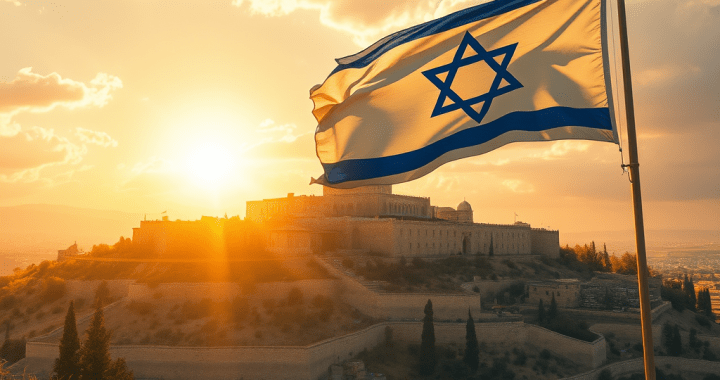
If you believe certain corners of the internet, Zionism is a cross between a Marvel super-villain origin story and a secret handshake society that meets under volcanoes.
It is neither.
It is, in fact, a remarkably ordinary idea with extraordinarily deep roots.
Let’s untangle it properly.
First: What Is “Zion”?
Zion is not a brand name. It’s not a political party. It’s not a shadowy lair.It’s a hill in Jerusalem.
For thousands of years, Jews prayed facing Jerusalem. Three times a day. At weddings. At funerals. At the end of Passover. At the end of Yom Kippur.
“Next year in Jerusalem.”
Not “Next year in Brussels.” Not “Next year in Brooklyn.”
Jerusalem.
The longing for return was baked into Jewish life long before modern politics existed. Long before passports. Long before nation-states.
So when we talk about Zionism, we are talking about the modern political expression of something ancient: the Jewish people’s desire to return to and live safely in their ancestral homeland.
That’s it. That’s the headline.
The Modern Bit
In the late 1800s, Europe was not exactly running a “Come As You Are” campaign for Jews. Enter Theodor Herzl.
Herzl wasn’t trying to build an empire. He was trying to solve a problem: Jews were being persecuted across Europe and had no sovereign refuge.
His proposal was radical only in its simplicity:
Jews are a people. People deserve self-determination. The Jewish people deserve it too.
That movement became known as Zionism. It eventually led to the establishment of the State of Israel in 1948.
So What Is Zionism?
At its core, Zionism is:
- The belief that the Jewish people have the right to self-determination in their historic and ancestral homeland.
- The belief that Jews are not only a religion, but a people with shared history and nationhood.
- The belief that Jewish safety requires sovereignty.
That’s it.
It is not a theological crusade. It is not a global domination plan. It is not a mystical laser subscription service. It is a national movement for national self-determination.
Which, awkwardly for its critics, is something almost every other nation on earth supports for itself.
What Zionism Is NOT!
Let’s clear the fog machine. Zionism is not:
- A belief that Jews are superior.
- A desire to harm others.
- A rejection of Palestinian identity.
- A colonial project in the classic sense.
Colonialism usually looks like this: a distant empire sends its people to extract resources from a foreign land for the benefit of the empire.
Zionism looked like refugees returning to a land they had prayed about for 2,000 years, buying land legally, draining swamps, building farms and speaking Hebrew again – the same language our People have spoken for around 3,000 years.
There was no Jewish “mother empire” in London or Paris sending settlers for profit. Most early Zionists were escaping pogroms and persecution, not chasing gold.
That does not mean the story is simple. It is not. Two national movements collided in one tiny patch of earth. Tragedy followed. Politics followed. Wars followed. But complexity is not colonialism.
The Scale Perspective
Here’s the part that always makes me blink.
Israel is about 0.001% of the world’s land mass.
A sliver. A postage stamp with WiFi.
And yet the word “Zionism” is treated like it’s a planetary event horizon. That reaction often tells you more about the speaker than the subject.
Zionism and Peace
Zionism does not require perpetual conflict.
In fact, many Zionists historically supported partition plans that would have created both a Jewish and an Arab state side by side.
The belief in Jewish self-determination does not negate anyone else’s right to theirs. The problem is not the existence of two national aspirations. The problem has always been whether both can coexist.
We do not want war or conflict. We never have. I often tell my Arab and Muslim friends that my greatest desire is to sit in one of our gardens, be it northern Israel, western Syria or southern Lebanon, eating hummus, olives and pita bread together, watching our kids run and play together whilst we discuss who makes the best falafel. That would be my dream and the dream of most Zionists/Jews.
Why the Word Feels So Charged
Because it is used as a proxy. For some, “Zionist” has become a socially acceptable substitute for “Jew.” When that happens, the word stops being political and starts being something much older. And that’s when history taps you on the shoulder and says, “Careful.”
The Bottom Line
Zionism is not a death cult. It is not a supremacist ideology. It is not a cosmic villain arc. It is a small, stubborn people saying:
We would like to live. In safety. In the place our story began.
That’s it.
You can debate policies. You can criticise governments. You can argue borders and leaders and elections until your coffee goes cold. But the core idea? Simply, a people wanting a home.
That is Zionism.
And frankly, in a world where everyone else gets to want that, it is not the scandal some make it out to be. If anything, it is one of the most ordinary ideas in human history.
It just happens to belong to the most discussed 0.001% on the map. 🌍
Discover more from Tribe 613
Subscribe to get the latest posts sent to your email.
Comments are closed