
There is an old, unofficial Jewish survival strategy.
When they try to kill us, we fight. When they try to erase us, we remember.When they try to break us, we rebuild.
And somewhere between the grief, the prayers, the arguments and the food… we laugh.
We always have.
Jewish history is hardly an obvious source material for comedy. Exile. Persecution. Pogroms. Expulsions. Terrorism. War. The Shoah. Thousands of years spent wondering whether the knock at the door is a neighbour coming to borrow some sugar or someone arriving to burn down the village.
And yet, somehow, we became one of the funniest peoples on earth.
Perhaps we had to.
Jewish humour was never simply entertainment. It was armour – although not the kind that stops a bullet. It was armour for the soul. A way of taking something terrifying, turning it around in our hands and finding the one angle from which it looked ridiculous.
Because once you can laugh at something, it no longer owns every part of you.
The pain may still be there. The loss is still real. The dead are still missed. But for one glorious moment, the darkness has been denied complete control of the room.
That is the peculiar magic of Jewish comedy.
It doesn’t wait for the wound to heal before making the joke. It sits beside us while we are still bleeding and whispers something so inappropriate that we laugh despite ourselves – and then feel slightly guilty for laughing.
So naturally, we laugh at the guilt too.
The Jewish Art of Laughing at Ourselves
Jewish humour is rarely about pretending everything is fine. Quite the opposite.
It begins with the understanding that almost nothing is fine. The world is absurd, people are exhausting, G-d works in mysterious ways, our mothers are worried, our fathers are disappointed, our children never call enough and somebody has definitely ordered the wrong thing in the restaurant.
We don’t laugh because life is easy. We laugh because life is impossible.
The Jewish joke often makes the Jew its first target. We mock our anxiety, our families, our traditions, our insecurities, our arguments and our uncanny ability to answer one question with six more.
It is self-deprecation, but not self-hatred.
There is an enormous difference.
Self-hatred says, “There is something wrong with us.”
Jewish humour says, “We are completely ridiculous – and we love ourselves anyway.”
That distinction runs through generations of Jewish comedy.
Mel Brooks took subjects others considered untouchable and attacked them with joyous, outrageous ridicule. His Nazis were not towering, terrifying figures. They were idiots, buffoons and dancing punchlines. He understood that mocking a monster can be its own form of revenge.
The Nazis wanted Jews frightened, silent and erased. Mel Brooks put them on stage and made the world laugh at them.
Jerry Seinfeld built an empire from the tiny irritations of ordinary life: queues, cereal, dating, dry cleaners, bad manners and the baffling behaviour of other human beings. Nothing needed to explode. No great moral lesson had to be delivered. The absurdity was already there, hiding in plain sight.
Jackie Mason turned the rhythm of Jewish conversation into an art form. The accent, the indignation, the suspicion, the argument that seems to have ended three times but somehow keeps finding new life. His comedy felt like being cornered by the funniest man in the synagogue while your food slowly went cold.
Joan Rivers refused to remain in the place society assigned to her. She was loud, relentless, brutally honest and gloriously dangerous. At a time when women in comedy were expected to be charming and accommodating, she was sharp enough to draw blood. She mocked celebrity, vanity, ageing, sex, failure and herself – especially herself.
Gilda Radner was wonderfully strange, vulnerable and fearless. Elaine May brought extraordinary intelligence and precision to comic performance. Madeline Kahn could steal an entire film with a look, a pause or a perfectly controlled explosion of madness.
Later, Sarah Silverman took innocence, discomfort and provocation, mixed them together and handed the audience a moral dilemma disguised as a joke. Alex Borstein brought Jewish anxiety, anger and resilience to characters who could be hilarious and heartbreaking in the same breath. Tiffany Haddish has spoken proudly and joyfully about discovering and embracing her Jewish identity, bringing another voice and another story into an already gloriously complicated family.
Adam Sandler created a different kind of Jewish comedy: scruffy, sentimental, childish, musical and unexpectedly tender. He didn’t merely admit to being Jewish in mainstream entertainment; he celebrated it. He made Jewish children hear their names, festivals and heroes in popular culture and realise they weren’t standing outside the party.
Sacha Baron Cohen turned discomfort into a weapon. Through characters who are outrageous, offensive and often almost unbearable to watch, he exposes what people will reveal when they believe nobody is judging them. The joke is rarely just the character. The real joke – and sometimes the real horror – is how readily ordinary people join in.
Jewish comedy has always pushed boundaries because Jewish existence has always been lived on boundaries: between countries, languages, cultures, safety and danger; between belonging and being reminded that we do not belong quite as much as we thought.
Perhaps that is why Jewish comedians so often notice what everyone else has agreed not to mention.
Israeli Humour Doesn’t Ask Permission
Israeli comedy shares the same ancient DNA, but it has its own flavour.
It is louder. Faster. More direct. Less interested in whether you are comfortable.
Israeli humour was forged in a country where tragedy and ordinary life constantly occupy the same space. A siren sounds, people run for shelter, somebody checks the news – and five minutes later someone complains that the shelter has terrible Wi-Fi.
Not because the danger is not real.
Because it is.
Israeli comedians such as Adir Miller, Shahar Hason, Guri Alfi, Orna Banai, Rotem Abuhab, Matan Peretz, Eretz Nehederet’s remarkable cast and many others have turned the chaos of Israeli life into something we can survive together. They joke about politics, religion, army service, ethnic differences, bureaucracy, relationships, reserve duty, Jewish mothers and the national inability to stand quietly in a queue.
Nobody is spared. That is part of the social contract.
If we are going to endure this madness together, everyone is getting roasted.
Since 7 October, that humour has become darker, more urgent and more necessary. There were weeks when laughter felt almost impossible – even disloyal. How could we laugh while families were grieving? How could we laugh while hostages remained underground? How could we laugh while soldiers were fighting and an entire country was carrying trauma in its chest?
But eventually, the comedians returned.
And people came to see them because they needed permission to breathe.
Not to forget. Never to forget. Just to breathe.
Yohay Sponder has become one of the clearest voices of that defiant Israeli humour. His comedy is proudly, unmistakably Jewish. He doesn’t shrink his identity to make an audience comfortable. He enlarges it. He walks onto stages around the world wearing a huge Magen David and turns antisemitism, trauma and the absurdity surrounding Israel into material.
I once heard him compare Christians wearing crucifixes with Jews wearing necklaces shaped like shower heads.
The air vanished from the room. For a fraction of a second, everyone froze.
Did he really just say that?
Then the room erupted.
Not because the Shoah is funny. It isn’t. It never will be.
We laughed because of the horrifying, perfectly constructed irony. Because one faith can wear the instrument used to kill its most sacred figure as a symbol of devotion, while the equivalent image for Jews would be considered unthinkably grotesque.
The joke forces you to see that contradiction in a way a lecture never could.
It takes one of the darkest images in Jewish memory and, for a few seconds, wrestles control of it away from the people who created it.
That laughter is not disrespect for the dead.
It is contempt for their murderers.
There are jokes that make us comfortable, and there are jokes that make us confront why we are uncomfortable. Jewish comedy has never been afraid of the second kind.
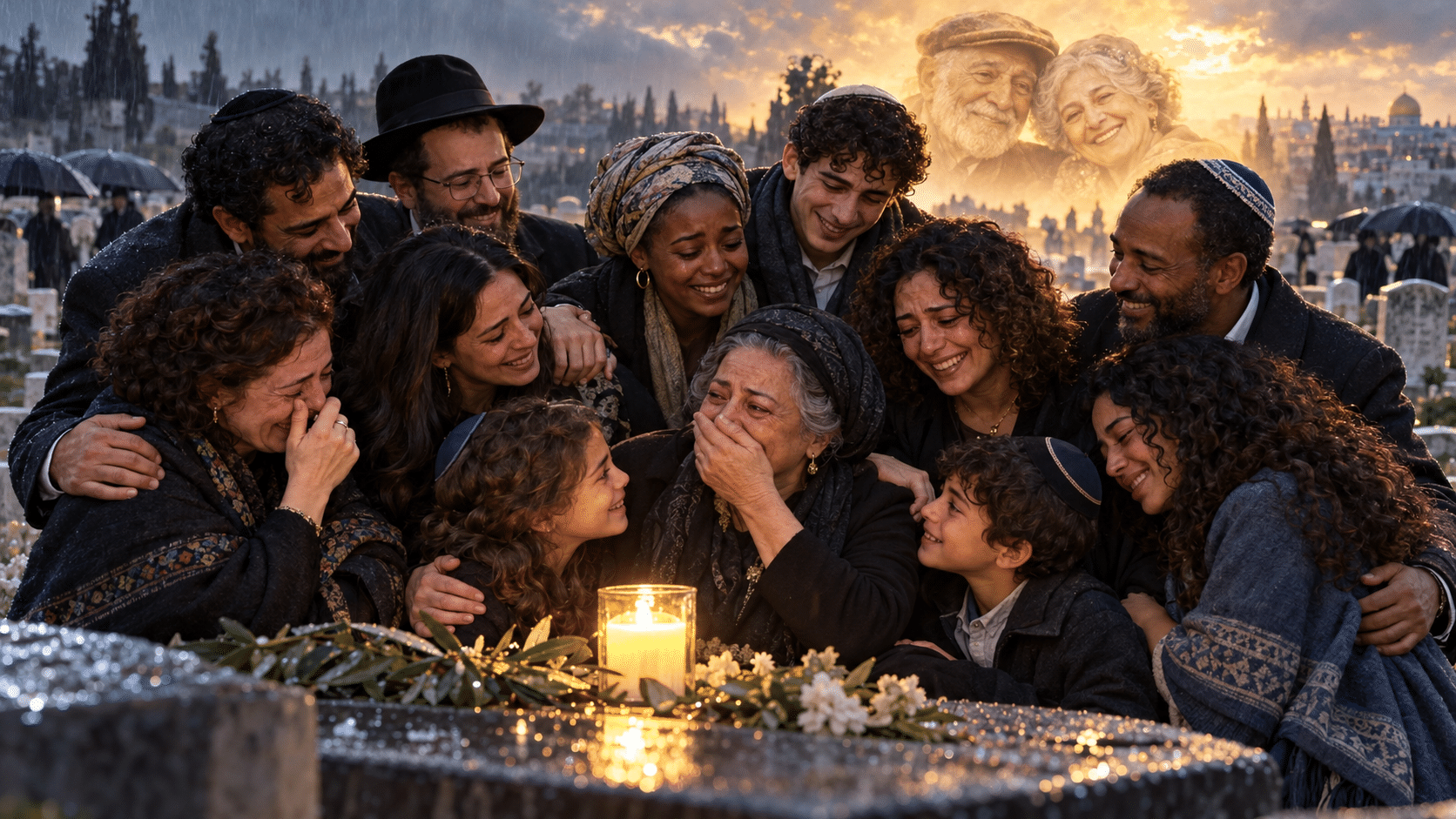
And Sometimes, We Laugh at the Graveside
This isn’t merely something I have observed in Jewish comedians. It is woven into my own family.
When my poppa died, I was fifteen or sixteen. It was the first funeral I had ever attended, and I remember the day vividly.
It was bleak, grey and raining. The ground around the grave was slippery with thick, sludgy mud. Everyone stood together beneath that miserable sky, heartbroken, as they began lowering my poppa’s coffin into the ground.
Then came a loud splosh.
The grave had partially filled with rainwater.
Everyone looked horrified. It was an awful sound in an already unbearable moment. Nobody knew where to look or what to say.
Then one of my uncles piped up:
“Should’ve stuck an outboard motor on it, shouldn’t we?”
There was a second of stunned silence. And then everyone fell about laughing.
Not because losing my poppa was funny. Not because the funeral mattered any less. But because, at precisely the moment the sadness threatened to swallow us whole, somebody threw us a rope.
It just happened to be attached to an outboard motor.
Sadly, my other poppa died that same year.
Then, eleven years to the day after my nanna’s husband, my poppa Frank, had died, my nanna Joy passed away too.
She had been terribly ill for several weeks, and we knew she probably had only days left. Yet somehow, she held on until the exact anniversary of the day her husband of sixty years had passed.
In Jewish tradition, we light a Yahrzeit candle on the anniversary of a loved one’s death. It burns for approximately twenty-four hours, allowing their memory – and their light – to remain with us.
The significance of the date did not escape any of us at her funeral.
We were devastated, but we imagined my poppa Frank standing impatiently at the foot of her bed, waiting to collect her:
“Come on, Joy. Heaven’s waiting. We’re going to be late. We have to go!”
And my nanna, in her own utterly inimitable style, abruptly turning towards him and replying:
“Frank, will you hold on and be patient! If we go tomorrow, they’ll only have to light one candle for both of us!”
That was them.
Even death couldn’t change the dynamic of sixty years of marriage. He was ready to leave. She was telling him to wait – and finding a practical way to save the family the cost of a candle.
And once again, in the middle of terrible loss, we laughed.
That laughter did not diminish our grief. It did not mean we loved them less or that their deaths hurt any less deeply.
It meant that, for a few moments, they were back with us.
We could hear their voices. See their faces. Remember the rhythms of their marriage and the tiny exchanges that had made them them. The joke transformed them from names on a memorial and bodies being lowered into the earth back into Joy and Frank – our nanna and poppa, still bickering somewhere beyond our sight.
Perhaps that is one of the greatest gifts humour gives us in grief.
It does not bring the people we love back to life.
But sometimes, just for the length of a joke, it brings them back into the room.
And so we laugh – even in the face of loss, death and unbearable sadness.
Especially then.
Laughter Is Not Forgetting
People sometimes misunderstand dark humour.
They assume that laughing at tragedy means minimising it. That joking about trauma means we have failed to take it seriously.
Usually, the opposite is true.
We joke about the things we carry most heavily.
Nobody knows the weight of Jewish history better than Jews. Nobody needs to remind us that the Shoah was not funny, that pogroms were not funny or that 7 October was not funny.
We know.
We carry the names. We recognise the photographs. We sit beside the empty chairs. We hear the testimonies. We watch our children encounter the hatred we had hoped they might be spared.
And still, sometimes, we laugh. Not at those who suffered.
For them. For ourselves. For the generations who were told that Jews would disappear, only to be answered by Jewish comedians standing beneath spotlights in New York, London, Paris, Tel Aviv and Jerusalem.
A Jewish joke is often a tiny declaration of continued existence.
You frightened us, but we are still laughing. You expelled us, but we took the joke with us. You tried to humiliate us, so we learned to humiliate ourselves better than you ever could. You tried to turn us into a tragedy. We insisted on remaining a people.
Tikkun for the Broken Spirit
We speak often about tikkun olam – repairing the world.
Perhaps Jewish humour offers another kind of repair: tikkun hanefesh, the repair of the soul.
It cannot bring back the people we have lost. It cannot eliminate trauma or heal every wound. It cannot end antisemitism, return the hostages or make the world suddenly understand us.
But it can loosen grief’s grip around the chest.
It can reconnect us to one another.
It can remind us that beneath the anger, fear and exhaustion, some living part of us remains untouched.
Laughter is breath returning to the body.
It is the crack through which light re-enters.
It is the broken heart discovering that, although it may never be entirely whole again, it can still beat.
Perhaps that is why Jewish humour can be so dark. We have never had the luxury of laughing only when life is easy. We learned to laugh in ghettos, in exile, in bomb shelters and during wars. We laughed at hostile governments, useless bureaucrats, antisemitic conspiracy theories and every enemy who confidently announced that this time – definitely this time – the Jews were finished.
Then we went home, complained about the journey and argued over where to eat.
Because laughter is not the opposite of grief. Sometimes, laughter is grief refusing to surrender.
We laugh at our enemies because they do not deserve to remain terrifying.
We laugh at ourselves because survival without humility can turn into bitterness.
We laugh at our pain because it belongs to us – and if it belongs to us, then we decide how its story is told.
We laugh because our hearts have been broken too many times.
We laugh because our souls need repairing.
We laugh because we are alive.
And after everything – every empire, every exile, every massacre, every war, every threat and every confident prediction of our disappearance – that may be the funniest thing of all.
We are still here. And still, we laugh.
Discover more from Tribe 613
Subscribe to get the latest posts sent to your email.
No responses yet