
Every time Israel confronts the Iranian regime, the same chorus begins.
“Israel is attacking Iran.”
“The West must return to negotiations.”
“This is illegal.”
But before slogans replace facts, something important needs to be said.
This is not a war against the Iranian people.
It is a confrontation with the Islamic Republic and the IRGC – the revolutionary regime that seized power in 1979 and has spent the past four decades suppressing its own population, exporting terror across the region and across the world, and openly calling for the destruction of Israel.
And that distinction matters.Because Persia and the Islamic Republic are not the same thing.
Persia Was Never the Enemy. Iran is heir to one of the world’s oldest civilisations.
Long before the modern Iranian state existed, the land was known as Persia, a culture that produced poetry, philosophy, science, architecture and trade that connected East and West for thousands of years.
It is also the birthplace of Zoroastrianism, one of the world’s oldest monotheistic religions.
Zoroastrianism emerged roughly 3,000-3,500 years ago, making it one of humanity’s earliest recorded religious traditions.
Judaism, tracing its origins back roughly 3,500-4,000 years, is slightly older but belongs to the same ancient era of religious history.
In other words, these two traditions and civilisations have existed side by side since the dawn of recorded monotheism.
And for most of that time, Persians and Jews were not enemies. Quite the opposite.
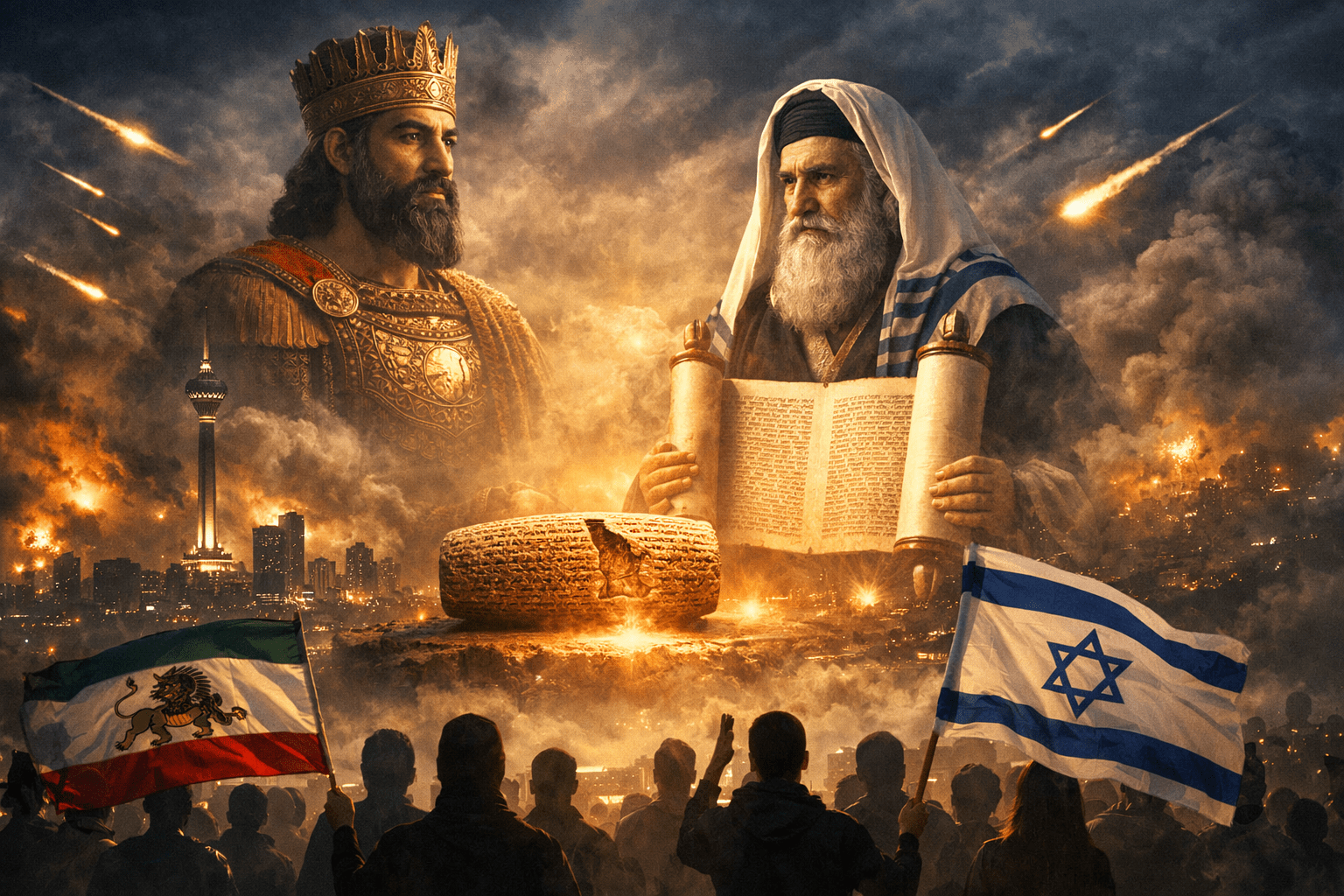
More than 2,500 years ago, the Persian king Cyrus the Great allowed the Jewish people to return to Jerusalem after the Babylonian exile and rebuild the Temple.
For that reason, Cyrus is remembered in Jewish history not as a conqueror but as a liberator. Jewish communities flourished in Persia for centuries.Even today, despite the hostility of the Islamic Republic, many Iranians in the diaspora proudly express solidarity with Israel and the Jewish people.
At demonstrations across Europe and North America, it is not uncommon to see the historic Persian flag of pre-1979 Iran flying alongside Israeli flags. A visible reminder that the conflict today is not between Persians and Jews. It is between a regime and the people it rules.
What the Regime Has Done to Its Own People
When the Islamic Republic replaced the Shah’s monarchy in 1979, Iran transformed from a modernising state with global connections into a clerical theocracy governed by religious ideology.
The Shah’s government had many flaws. But the system that replaced it fundamentally reshaped Iranian society.
Today tens of millions of Iranians live under extraordinary restrictions.
Women can be beaten, imprisoned or even killed for violating strict dress codes. Students are arrested for speaking out. Journalists disappear. Protesters are shot in the streets.
The world saw this clearly after the death of Mahsa Amini in 2022, which sparked the nationwide “Woman, Life, Freedom” protests.
Young people filled the streets demanding dignity and freedom.
The regime responded with violence.
According to internal documents and testimony reviewed by Iran International, more than 36,500 Iranians may have been killed during a two-day crackdown on protests, making it one of the deadliest episodes of political repression in modern times.
Women. Students. Workers. Ordinary citizens asking for freedom.
Shot, imprisoned or simply disappeared.
So when Western politicians speak casually about negotiating with the Iranian regime, it is worth remembering who they are proposing to negotiate with.
Not reformers. Not moderates. A regime that massacres its own citizens to stay in power.
Exporting Terror – Not Just in the Middle East
While repressing its own population, the Islamic Republic has spent decades exporting instability.
Through the Islamic Revolutionary Guard Corps (IRGC), Iran has funded, armed and trained proxy groups including:
Hamas. Hezbollah. The Houthis. Militant networks across Iraq and Syria
But this strategy has never been limited to the Middle East.
Iran’s regime has also spent decades exporting radical Islamist ideology and destabilising influence across Europe, North America and beyond.
It has supported global terror networks, funded propaganda, and built ideological influence structures designed to weaken Western democracies from within.
Israel is simply the most immediate target.
The West is not far behind.
The Selective Outrage
One of the most revealing parts of the global debate is not what people protest.It’s what they don’t protest.
On October 7th, 2023, Hamas launched the deadliest attack on Jews since the Holocaust. More than 1,200 people were massacred. Families were burned alive. Women were raped. Entire communities were destroyed. 251 hostages were dragged into Gaza, many held in captivity for more than 800 days.
Yet before Israel had even begun its full military response, crowds were already gathering across the world accusing Israel of genocide.
For nearly two years, weekly demonstrations filled the streets of London, New York, Paris and countless university campuses.
But when reports emerged indicating that tens of thousands of Iranians had been slaughtered by their own regime, those same streets were silent.
No encampments. No weekly marches. No global outrage.
The contrast could not be clearer.
When Jews defend themselves, the world erupts in protest. When a brutal regime massacres its own citizens, the silence is deafening.
The United Nations Paradox
Then there is the United Nations.
In one of the more surreal moments in recent diplomacy, Iran was appointed to chair the UN Human Rights Council’s Social Forum in 2023. A regime that jails journalists. Executes protesters. Beats women for showing their hair.
That regime was placed in charge of discussions about human rights.
At the same time, Israel – the only democracy in the Middle East — continues to receive a disproportionate share of UN condemnations for defending itself against terror groups that openly call for its destruction.
The irony would be amusing if it were not so dangerous.
The Reality
Israel is not at war with Persia.
Israel is confronting a regime that:
- Murders its own people
- Exports terrorism across the globe
- Funds violent proxies across the Middle East
- And openly calls for the destruction of the Jewish state
Many Israelis do not want Iran destroyed. They want Iran free.
Free from the regime that has oppressed its people, destabilised the region and turned an ancient civilisation into a revolutionary state. And when that day comes, the friendship between Persians and Jews – a relationship stretching back thousands of years – will once again have the chance to flourish.
But until then, one truth remains.
Israel will not wait for the moment its enemies acquire the very weapons they promise to use. And it will not apologise for defending its people.
Because after thousands of years of persecution, the Jewish people have learned one lesson above all others:
When someone repeatedly tells you they intend to destroy you, believe them.
Discover more from Tribe 613
Subscribe to get the latest posts sent to your email.
No responses yet