
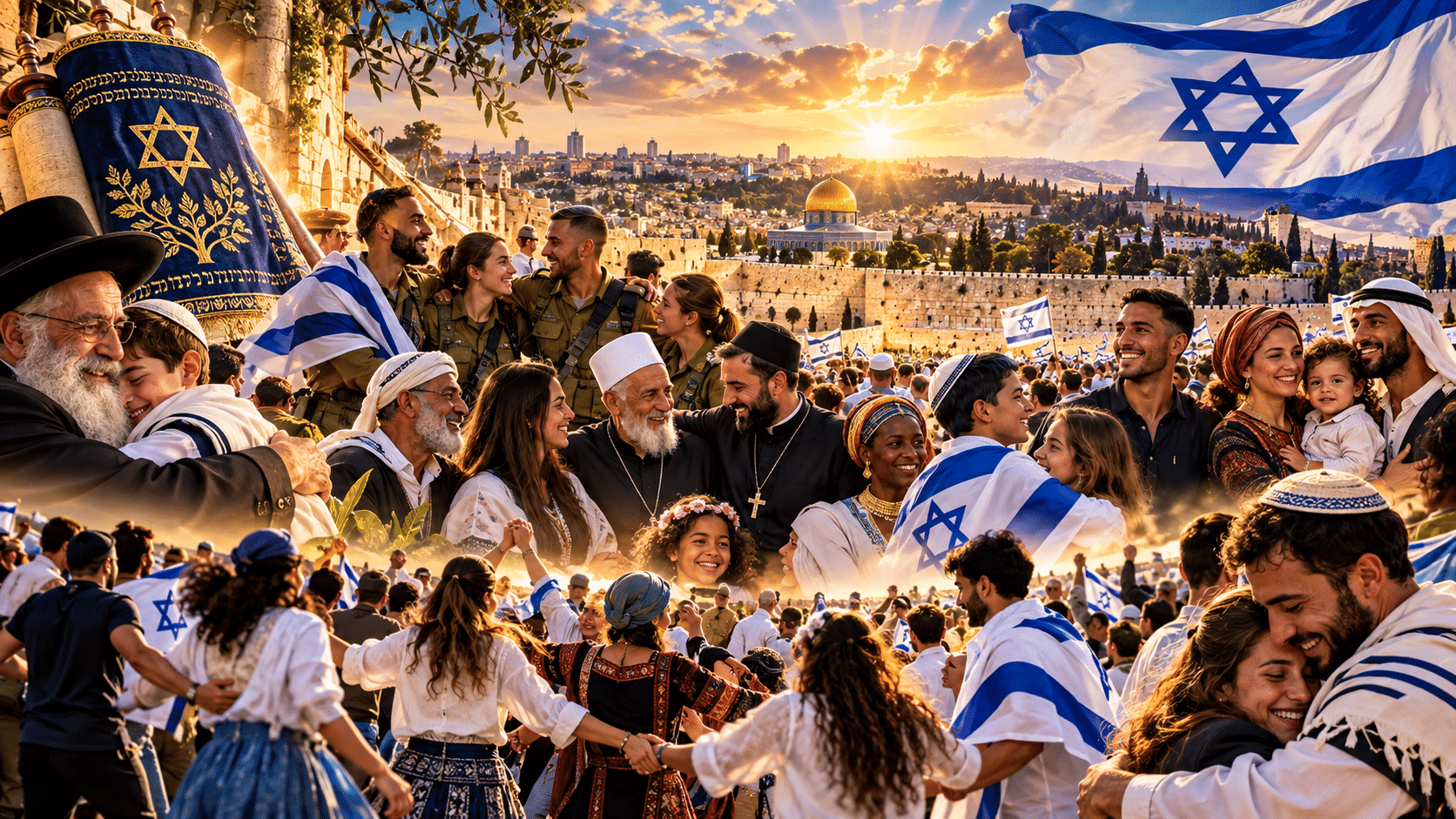
Today is 7 October 2026. Three years. Three years since Israelis woke to sirens, gunfire and the unimaginable reality that our border had been breached and our people were under attack again.
Three years since Jewish families were murdered, kidnapped and hunted in their homes, at a music festival, on roads and in communities beside Gaza.
Three years since something very old suddenly felt horribly present again.
And perhaps today, of all days, there is something we need to remember.
Not about them. About us. Because we Jews are exceptionally talented at arguing.
Honestly, it may be one of our oldest traditions. Two Jews, three opinions. Four Jews, seven shuls, nine committees and at least one person insisting the bagels were better where their grandmother grew up.
Ashkenazi. Sephardi. Mizrahi. Ethiopian. Yemenite. Persian. Iraqi. Moroccan. Polish. Russian. British. American. Israeli. Orthodox. Reform. Conservative. Masorti. Chabad. Chassidish. Traditional. Secular. Somewhere-in-the-middle-ish. Black hat. Knitted kippah. Baseball cap. No hat. Tzitzit hanging out. Tzitzit tucked in. No tzitzit at all. Peyot. Fade. Bald.
Someone will undoubtedly tell me that one of those is halachically preferable.
And that is precisely the point.
We spend an extraordinary amount of time discussing the things that distinguish us from one another while occasionally forgetting the enormous thing that connects us.
We are Am Yisrael
One people. One ancient family.
For those of us born Jewish, our ancestry reaches backwards through generations of Jews who lived in different countries, spoke different languages, cooked different foods and prayed with different melodies, yet remained part of the same people.
And those who chose Judaism and joined our people became part of that family too.
Because Jewish identity has never been just one thing. It is religion. It is ancestry. It is culture. It is memory. It is peoplehood. It is history. It is belonging.
And depending on the Jew you ask, one of those may matter more than another. But none exists entirely on its own.
Our shared story reaches back to the land of Israel, to Jerusalem, to Judea and Samaria, to the kingdoms of Israel and Judah, to the patriarchs and matriarchs, to prophets, kings and generations whose stories became part of our collective memory.
Then history scattered us across the planet: Babylon. Persia. North Africa. Yemen. Iraq. Iran. Ethiopia. Spain. Portugal. Italy. Germany. Poland. Russia. Britain. America.
And almost everywhere else Jews could find somewhere to plant a tree, build a synagogue, open a bakery and argue about the correct way to make something their neighbours were absolutely certain they had invented.
We absorbed languages. We developed different customs.
Our food changed. Our clothes changed. Our accents changed. Our melodies changed.
Even our Hebrew pronunciations changed.
But something remarkable happened: We didn’t stop being us.
A Jew in Baghdad and a Jew in Warsaw could look completely different. A Jew in Fez might eat differently from a Jew in Vilnius. A Yemenite Jew might pray with melodies an Ashkenazi Jew had never heard before.
But Jerusalem was still Jerusalem.
Shabbat was still Shabbat. Pesach still told the story of leaving Egypt. The Torah was still the Torah. And Am Yisrael was still Am Yisrael. And strangely, this shouldn’t even be difficult to understand.
Because we understand layered identity perfectly well when we talk about almost everybody else.
A family can leave India and build a life in Britain. Their children can be born in London. Their grandchildren can grow up supporting England, complaining about the weather, paying British taxes and arguing about whether the Tube counts as functioning public transport.
They are British.
Nobody needs a DNA test before allowing them to say so.
But nobody is confused when they also describe themselves as Indian, British Indian, Punjabi, Gujarati, Sikh, Hindu or any combination of those things.
One identity does not delete the other.
A Chinese family can live in Britain for generations and still preserve Chinese language, food, festivals and cultural traditions. They are British. They can also be Chinese. These ideas coexist perfectly comfortably.
A Black American whose ancestry reaches back to Africa is American. Completely American. Their family’s contribution to America may stretch back generations. And yet the term African American itself acknowledges something beautifully obvious: Citizenship and ancestral identity can occupy the same human being at the same time.
We understand this. We accept it. We even have language specifically designed to describe it.
British Indian. British Chinese. African American. Scottish Pakistani. Italian American. Irish American.
Nobody hears those phrases and screams: “PICK ONE!”
Nobody says: “Well, your grandparents left India seventy years ago, so you’re obviously not Indian any more.”
Nobody seriously argues that because a Chinese family has lived in Manchester for three generations, Chinese history somehow ceased to be part of their identity.
Nobody expects an African American to demonstrate that their connection to Africa was continuously maintained through an uninterrupted chain of passports.
Because that would be ridiculous. Migration does not erase ancestry. Citizenship does not erase culture. Assimilation does not delete history. Living somewhere else does not magically rewrite where your people came from.
And yet somehow, when the people involved are Jews, all of these perfectly ordinary rules of identity suddenly seem to malfunction.
A Jew whose ancestors were forced into Europe becomes simply European. A Jew whose family lived in Iraq becomes simply Iraqi. A Jew from Morocco becomes Moroccan. A Jew from Poland becomes Polish.
And the ancient identity connecting all of them to one another and to the land of Israel is sometimes treated as though it were a religious fairy tale we conveniently invented in 1948.
That is bizarre.
My family living somewhere else does not erase who they were before they arrived there.
Exile does not become origin simply because it lasts a long time.
If an Indian family spends four generations in Birmingham, Birmingham does not suddenly become the ancestral birthplace of Indians.
Why would the equation become different for Jews?
A British Jew can be completely, wholeheartedly British.
Drink tea. Queuing skills at Olympic level. Moan about potholes. Know that a barbecue must legally begin five minutes before it rains.
And still be Jewish.Still belong to Am Yisrael. Still carry a history that did not begin in Britain.
A third-generation British Indian restaurant owner in Bethnal Green is not somehow 60% British on Tuesdays and 40% Indian after 6pm.
He is both. So am I.
Israeli, British and Jewish are not rival job applications.
Neither are American and Jewish. French and Jewish. Australian and Jewish. Or Israeli and Jewish.
This is not complicated. Until, apparently, Jews are involved.
And on today of all days, that distinction feels particularly important.
Because on 7 October 2023, the people who crossed into Israel did not stop to conduct theological interviews.
They did not ask: Ashkenazi or Sephardi? Religious or secular? Left wing or right wing? Kippah or no kippah? Kosher home or bacon sandwich? Which rabbi? Which shul? How often do you daven? They did not care.
Jews were Jews. Israelis were Israelis. And anyone standing between the attackers and their victims was an obstacle.
Our enemies have rarely shown much interest in our internal filing system.
The Crusader didn’t stop to ask whether you were sufficiently observant. The inquisitor didn’t ask which siddur you used. The pogromist didn’t check whether your grandparents came from Poland or Morocco. The Nazi didn’t care whether you ate kosher.
And on 7 October, Hamas did not ask which synagogue people attended before murdering and kidnapping them.
Perhaps there is something important in that uncomfortable truth.
Those who hate us often understand our peoplehood better than we do.
And yet we continue handing ourselves little knives and cutting ourselves into ever smaller pieces.
Too religious. Not religious enough. Too Israeli. Too diaspora. Too Ashkenazi. Too Mizrahi. Too left. Too right. Wrong rabbi. Wrong synagogue. Wrong pronunciation. Wrong kippah. Wrong opinion. We make ourselves smaller.
And every crack between us creates somewhere for someone else to push a wedge.
Nobody is suggesting we need to agree. Good luck with that. We have been arguing with one another for several thousand years and I see absolutely no evidence that we’re planning to stop before lunch.
Nor should we.
Debate is woven into Jewish culture. Open a page of Talmud and you don’t find everybody politely nodding at Rabbi Whatsisname. You find arguments. Questions.
Counterarguments. Minority opinions preserved alongside majority ones. Our tradition does not fear disagreement.
But disagreement is not the same thing as division.
That distinction matters enormously.
I can disagree with another Jew and still recognise him as my brother. I can worship differently from another Jew and still recognise her as my sister. I can think someone’s political opinion is completely bonkers and still understand that if someone comes for them because they are Jewish, I stand beside them.
There is an ancient Jewish principle: כל ישראל ערבים זה בזה. Kol Yisrael arevim zeh bazeh.
All Israel is responsible for one another.
Not: All Jews who vote the same way. All Jews who attend the same synagogue. All Jews who follow the same rabbi. All Jews whose grandmother made the correct kugel.
All Israel.
Every one of us.
But here is where the language becomes even more interesting.
Because Am Yisrael, the Jewish people, and the State of Israel are deeply intertwined, but they are not identical things.
Not every Jew is Israeli. And not every Israeli is Jewish.
That sounds obvious, yet people constantly collapse those identities into one another.
A Jew in London, Paris, New York or Melbourne may never have held an Israeli passport and is still part of Am Yisrael. Meanwhile, millions of Israelis are not Jewish: Muslim. Christian. Druze. Bedouin. Circassian. Arab Israeli.
And here we encounter the identity problem from the opposite direction.
Because sometimes the very people who insist that Jews cannot possibly maintain an ancient connection to Israel after generations abroad will then turn around and tell an Arab, Druze or Christian Israeli that their Israeli identity isn’t real either.
Apparently nobody is allowed to be Israeli correctly.
A Druze Israeli says: “This is my country.”
Someone tells him he is a traitor.
An Arab Israeli says: “I am Israeli.”
Someone tells him he has been brainwashed.
A Christian Arab Israeli defends his country publicly and people thousands of miles away who have never met him, never lived there and perhaps couldn’t find his hometown on a map explain that he doesn’t understand his own identity.
How breathtakingly patronising is that?
Because if we grant everybody else the dignity of defining themselves, why suddenly take that dignity away from Israelis?
Look at Yoseph Haddad.
Arab. Christian. Israeli.
Those three words do not contradict each other. They describe one man.
Or Ali Shaa’ban.
Druze. Israeli. Again, there is no contradiction to solve.
Ali does not become less Druze by being Israeli.
Yoseph does not become less Arab by being Israeli.
Any more than a British Jew becomes less Jewish by being British.
That is the point. Identity can layer without cancelling itself.
And 7 October revealed that reality in the most brutal and beautiful ways imaginable.
Because when Israelis were attacked, Israelis responded.
Jews responded. Druze responded. Bedouin responded. Muslims responded. Christians responded. Police officers. Soldiers. Paramedics. Doctors. Neighbours.
Ordinary people who grabbed car keys, medical bags, weapons, phones, whatever they had, and went towards danger because other human beings needed them.
That is Israel too.
Not a neat diagram. Not a slogan. Not an internet argument.
People.
Yoseph and Ali matter in this conversation not because this article is about them. It isn’t. They matter because they make something abstract suddenly impossible to ignore.
Jewish identity and Israeli identity overlap enormously, but they are not the same thing.
One is an ancient peoplehood. One is a modern citizenship and national identity. For millions of people, they are both. For millions of Jews outside Israel, only the first applies. For many Israelis, only the second applies.
And somehow all of those circles meet inside the same extraordinary, complicated story.
Look at the IDF: You find Jews whose families came from Morocco, Iraq, Ethiopia, Russia, Poland, Yemen, Iran, Britain, France, America and countless other places. Religious Jews. Secular Jews. Kibbutzniks. City kids. People who put on tefillin every morning and people who probably couldn’t tell you which way round the boxes go.
And serving alongside them can be Druze, Bedouin, Muslim and Christian Israelis.
Different faiths. Different family histories. Different communities.
The same uniform. Not because their identities disappear when they put that uniform on.
Precisely the opposite.
They bring those identities with them.
Arab. Christian. Druze. Jewish. Muslim. Israeli. When they are hungry, cold, wet, exhausted or afraid, nobody stops to ask what the person beside them believes.
Nobody needs to know which synagogue, mosque or church he attends. Nobody cares whether he prays at all.
What matters is that he has your back. What matters is that you trust him with your life.
In those moments identity is not erased. It is placed inside something larger: Shared duty. Shared danger. Shared citizenship. Shared home.
When the alarm sounds, nobody asks: “Which shul do you go to?”
And nobody asks: “Hang on, are you Jewish?”
They see a fellow soldier. A fellow citizen. A human being. Someone whose life matters. Someone whose life may depend on yours.
That is Israel.
And perhaps that is something 7 October taught us again at terrible cost.
When somebody comes to kill you, the differences we spend so much time obsessing over become very small indeed.
And when somebody comes to save you, those differences often disappear just as quickly.
That does not mean identity stops mattering. It means we finally remember which identities matter together.
Am Yisrael is the Jewish people.
Israel is the Jewish homeland and a modern state whose citizens include Jews and non-Jews alike.
Those two things are deeply connected. They are not interchangeable. And understanding the distinction does not weaken either one.
It makes both clearer.
Our Jewish peoplehood existed long before the modern State of Israel. And the modern State of Israel contains people whose ancestry and religion are not Jewish, yet who are woven deeply into its society and destiny.
Golda Meir was Israeli. So is Yoseph Haddad. So is Ali Shaa’ban. They are not Israeli in the same way. They do not need to be. That is rather the point.
British identity does not demand that every British citizen share the same ancestry, religion or family story. Neither does Israeli identity.
And Jewish identity does not vanish because a Jewish family spent centuries somewhere else.
These are basic ideas we seem perfectly capable of understanding everywhere else.
Perhaps we should extend Jews and Israelis the same intellectual courtesy.
We are not a collection of unrelated religious denominations who happen to share a book. We are a people. A civilisation. A family. A tribe that somehow survived exile, persecution, expulsions, massacres, pogroms and genocide while carrying fragments of the same story across continents.
Some carried Torah scrolls. Some carried recipes. Some carried songs. Some carried keys to homes they would never see again. Some carried nothing except their children.
But they carried us forward. Generation after generation. Until eventually there was us.
And now the responsibility belongs to us.
Three years ago, families hid in safe rooms waiting for someone to come.
Soldiers ran towards communities under attack. Police officers fought. Medics treated whoever lay in front of them. Neighbours rescued neighbours. Strangers rescued strangers.
And Jews thousands of miles away who had never met any of them watched their phones and televisions with a feeling almost impossible to explain to someone who does not understand what Am Yisrael means.
They were strangers. But they weren’t. They were ours.
That feeling is peoplehood.
Not politics. Not theology. Not passports. Something older. Something deeper. Something that survived every border our ancestors were pushed across.
And perhaps three years later, after everything that has happened since, that is exactly what we need to remember.
We do not have to become identical. Quite the opposite.
There is something extraordinary about the fact that Am Yisrael contains so many traditions, colours, languages, melodies, foods and ways of expressing Jewish life.
And there is something equally extraordinary about the fact that Israel itself contains Jews, Muslims, Christians, Druze and others who may understand their identities very differently but still share cities, hospitals, schools, workplaces, danger and hope.
Unity does not require uniformity.
A family doesn’t stop being a family because everyone argues at dinner. In a Jewish family, frankly, that may be how you know dinner has actually started.
But today, perhaps we can argue a little less about who belongs in which box. Because before Ashkenazi and Sephardi. Before Orthodox and Reform. Before left and right. Before London, New York, Tel Aviv, Jerusalem, Paris, Melbourne or Johannesburg. Before your synagogue. Before your rabbi. Before your politics. Before the argument.
There is Am Yisrael.
And alongside that ancient people stands the modern reality of Israel, where Jewish identity, Israeli identity and countless other identities overlap without cancelling one another out.
We do not need to flatten those distinctions. We need to understand them.
Because a Jew can be British and Jewish. French and Jewish. American and Jewish. Israeli and Jewish. And an Israeli can be Jewish. Muslim. Christian. Druze. Arab. Circassian. Or something else entirely.
Identity is not a single box.
It is often a collection of circles. Some inherited. Some cultural. Some religious. Some national. Some chosen. Some thousands of years old.
And we happily understand that complexity in Indian families, Chinese families, African diaspora communities, Irish Americans, Italian Americans and countless others.
Jews deserve the same courtesy. So do Israelis.
So argue. Debate. Disagree. Roll your eyes at each other’s rabbis. Fight over whose grandmother makes the best challah. Tell me my hummus is wrong if you absolutely must.
Tomorrow, we can probably resume arguing about everything.
But today? Today is 7 October.
Today I would rather remember the people who were taken from us. The people still carrying what happened to them. The families permanently changed. The communities that woke one morning and found history crashing through their doors.
And the extraordinary people, Jewish and non-Jewish, who ran towards them.
Today I would rather remember that when they came for us, they did not care which kind of Jew we were.
And when Israelis ran to defend one another, many did not care whether the person beside them was Jewish at all.
That should tell us something. Something worth carrying into the fourth year.
We are Am Yisrael. We are responsible for one another.
A Jew does not cease being Jewish because his passport says British. An Israeli does not cease being Arab because she carries an Israeli passport. A Druze Israeli does not need someone in London, New York or university seminar room number 4B to grant them permission to call Israel home.
And nobody gets to tell another human being that an identity they have lived, inherited, defended and contributed to somehow does not count because it makes somebody else’s political narrative untidy.
Three years ago they tried to break Israel. They tried to break Jewish hearts. They succeeded in breaking far too many individual lives.
But they did not break Am Yisrael.
Three years later, we are grieving. We are scarred. We are angry. We are still arguing, obviously. We are Jews.
But we are still here. Still building. Still remembering. Still loving. Still carrying one another. Still arguing over hummus. Still refusing to disappear.
We still recognise one another. We still belong to one another. We are still here.
Today, especially today, remember that.
עם ישראל חי. 🔯💙 Am Yisrael Chai.
Discover more from Tribe 613
Subscribe to get the latest posts sent to your email.
No responses yet