
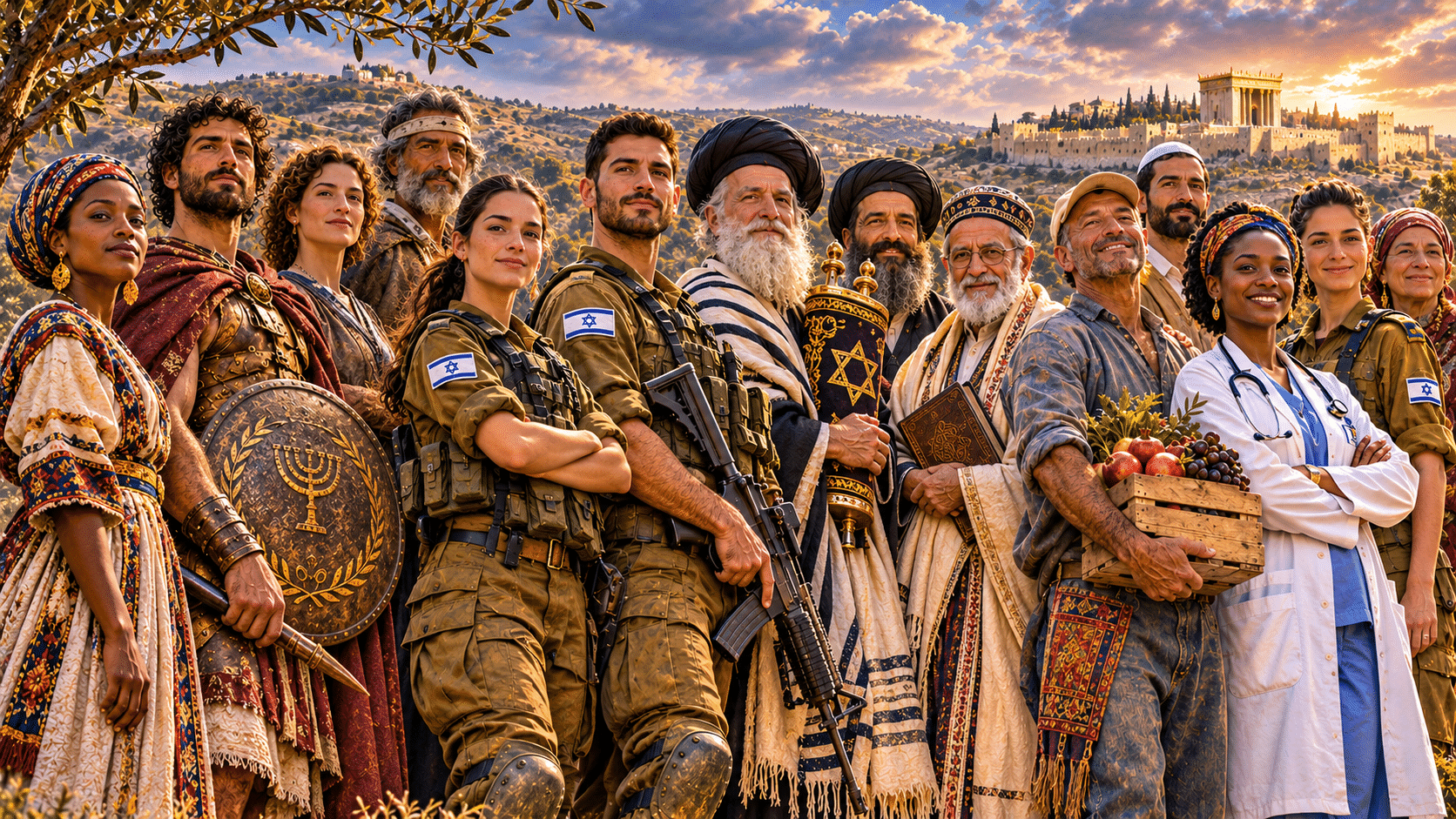
For thousands of years, we carried our history in books, our homeland in our prayers and our courage in our hearts. Today, we carry something else again. The ability to defend ourselves.
Long before the great rabbis of Europe. Long before the mystics of Safed sat beneath the Galilean stars contemplating the mysteries of creation. Long before the great academies of Babylon, the philosophers of Spain or the extraordinary Jewish minds that would help change the modern world, we were something else.
We were tribes.
We were shepherds and farmers. Builders and craftsmen. Families living in villages scattered across the hills and valleys of an ancient homeland.
We worked the earth. Raised our children. Tended our flocks. Argued, celebrated, worshipped, loved and fought.
We were deeply spiritual, certainly. Our relationship with G-d shaped our understanding of ourselves and our responsibilities to one another.
But we were also fiercely physical people.
We knew the weight of a sword. The feel of a shield. The importance of defending a village, a harvest, a family.
We weren’t merely a people who prayed for protection.
We were a people who protected.
And somewhere along the extraordinary, painful, miraculous journey of Jewish history, that part of our identity became harder to recognise.
Not because we forgot it.
But because the world increasingly denied us the opportunity to live it.
Before We Were the People of the Book
Think about the people whose names we still teach our children.
Joshua leading the Israelites across the Jordan. Deborah, a prophetess and judge, helping lead a people through war. David, the shepherd boy who became a warrior and king.
The Maccabees, refusing to surrender their religious identity under Seleucid rule.
The defenders of Jerusalem.
The rebels who challenged the might of Rome, even when the odds were overwhelmingly against them.
And then there were the Philistines.
An ancient people who settled along the southern coastal plains of our homeland, establishing five powerful city-states: Aza (Gaza), Ashkelon, Ashdod, Gat (Gath) and Ekron.
From these strongholds, the Philistines became formidable rivals of the ancient Israelites, fighting for territory, influence and control.
Their conflicts became woven into our earliest histories. Samson and the Philistines. Saul and the Philistine armies. David and Goliath.
These weren’t merely stories about courage. They reflected a world in which our ancestors repeatedly had to fight to defend their communities and their place in the land.
These were not mythical superheroes. They were people living through the harsh realities of their times.
They made mistakes. They disagreed. They fought among themselves, sometimes disastrously. They faced enemies more powerful and better equipped than themselves.
And they understood something fundamental.
If you cannot defend your home, someone else can take it from you.
For all the extraordinary spiritual and moral teachings that emerged from ancient Israel, its people also understood the practical business of survival.
There was no contradiction between studying the sacred and defending the land.
The same hands could hold a scroll and a sword.
The same people could debate justice and fight against oppression.
The same community could value peace while recognising that peace sometimes needed protecting.
This was part of who we were. And then our world began to fracture.
When the Land Was Taken
Our history was shaped by successive conquests, defeats, occupations and expulsions.
The Assyrians destroyed the northern Kingdom of Israel. The Babylonians conquered Judah and destroyed the First Temple. Centuries later came Hellenistic rule, Roman domination, rebellion and devastating repression.
The destruction of the Second Temple in 70 CE was catastrophic. The crushing of the Bar Kokhba revolt some six decades later brought further devastation.
And then came another humiliation.
Following the Bar Kokhba revolt of 132–135 CE, Rome crushed the Jewish rebellion, devastated Judaea and renamed the province: Syria Palaestina.
Judaea, the ancient homeland of the Jewish people, was stripped of the name that had proclaimed its connection to us.
The Romans drew upon an older geographical name associated with the ancient Philistines, whose armies had fought against our ancestors centuries earlier.
Consider the cruelty of that symbolism.
Our cities had been destroyed. Our people had been slaughtered, enslaved and displaced. Our rebellion had been crushed beneath the weight of an empire.
And now, even the name of Judaea was to disappear from the Roman map.
The result was unmistakable. A land whose very name acknowledged its Jewish history had been given a new identity under imperial rule.
But Rome had misunderstood something fundamental about the people it had conquered.
Our connection to our homeland was never dependent upon the permission of an emperor.
It was written into our history, our language, our prayers, our festivals and the very foundations of our civilisation.
Rome could rename Judaea.
It could destroy our Temple.
It could scatter our people.
But it could not make us forget who we were.
And nearly two thousand years later, when Jewish sovereignty was restored in our ancestral homeland, the descendants of those ancient Israelites were still speaking of Jerusalem, still reading the Torah and still carrying the memory of the land that Rome had placed beneath another name.
Empires can change maps. They cannot rewrite the truth of a people’s origins.
But Jewish life in our homeland did not simply disappear.
Communities endured through Byzantine, Islamic, Crusader and Ottoman rule, while Jewish populations had already established themselves across the wider world.
The diaspora was never a single event. Nor was it a single journey.
It unfolded over centuries, through conquest, forced displacement, migration, commerce, opportunity and persecution.
Some left because they had no choice.
Others travelled because they could build a life elsewhere.
Many stayed.
And those who found themselves scattered across distant lands faced a challenge that would shape the next two thousand years.
How do you remain a people when you no longer control the land on which your people began?
How do you preserve a language when surrounded by other languages?
How do you maintain a history when your children grow up in places their ancestors never knew existed?
How do you protect a civilisation when you cannot always protect its people?
Our ancestors found an answer so extraordinary that it still takes my breath away.
They carried their homeland with them.
Not in suitcases or on the backs of horses.
But in their minds.
In their hearts.
And, perhaps most importantly, in their words.
We Built Fortresses Out of Books
As Jewish communities spread across continents, something remarkable happened.
We became masters of a different kind of survival.
We studied. We wrote. We questioned. We argued.
Oh boy, did we argue!
If you put three Jews around a table with a single question, there’s a reasonable chance you’ll end up with seven answers, twelve disagreements and someone demanding to know why nobody has eaten yet.
But beneath that very Jewish tendency to question absolutely everything was something profound.
We understood that memory was survival.
Our texts became a bridge between generations.
Our traditions became a connection between communities separated by thousands of miles.
Our prayers preserved the names of places many Jews had never seen but somehow knew intimately.
Jerusalem was no longer simply a city.
It was a longing. A memory. A promise.
The Torah, the Mishnah, the Talmud and the vast libraries of Jewish thought became portable foundations of civilisation.
When our buildings were destroyed, we could rebuild.
When our possessions were confiscated, we could begin again.
When we were expelled from one country, we could carry our learning into another.
From Babylon to Baghdad, from Córdoba to Cairo, from Fez to Kraków, our intellectual and spiritual worlds expanded.
In Safed, centuries later, mystics explored the relationship between the divine and the human soul.
Elsewhere, Jewish physicians, poets, astronomers, merchants, philosophers and scholars enriched the societies in which they lived.
We turned knowledge into a form of resistance.
And it worked.
Empires collapsed.
Dynasties disappeared.
Languages vanished.
Entire civilisations became little more than dusty chapters in history books.
Yet the Jews remained.
A small, scattered people, holding on to an astonishingly ancient identity.
There is something beautiful about that.
But there was also a terrible price.
The Price of Being Defenceless
For centuries, Jewish communities lived largely at the mercy of rulers, neighbours and governments whose protection could be withdrawn almost overnight.
One king welcomed us. Another expelled us.
One city permitted us to prosper. Another confined us behind walls.
We could be respected physicians in one generation and accused of poisoning wells in the next.
We could build businesses, schools and synagogues only to see them confiscated, vandalised or burned.
We could contribute enormously to the societies around us, yet still be treated as permanent outsiders.
Sometimes protection came at a financial price.
Sometimes it required submission.
Sometimes it was simply an illusion.
And when the mobs arrived, when governments turned against us, when the laws changed and the doors were barred, who was going to protect us?
We could pray. We could protest. We could appeal to reason, justice, morality and common humanity.
But too often, we had no army to call upon. No sovereign institutions prepared to defend us. No dependable refuge.
That is not to say we stopped fighting. Far from it.
Jewish communities organised self-defence. Jews fought in the armies of the countries they called home. Jewish partisans resisted the Nazis. Fighters in the Warsaw Ghetto rose against an enemy they knew they could never defeat militarily.
Even in the extermination camps, where human beings had been stripped of almost everything, there were uprisings.
And resistance wasn’t always armed.
A parent secretly teaching a child Hebrew under threat of death was resisting.
A family lighting candles behind closed shutters was resisting.
A rabbi preserving sacred texts while the world outside tried to erase his people was resisting.
We never lost our courage.
What we lost, for much of our history, was the ability to organise that courage into the defence of an entire people.
And the consequences were unimaginable.
Never Again Must Mean Something
The Shoah exposed the most horrific consequences of Jewish powerlessness.
Six million of our people were murdered.
Not because they had failed to assimilate.
Not because they lacked education.
Not because they had failed to contribute to European civilisation.
They were murdered simply because they were Jews.
Among them were scientists, soldiers, musicians, philosophers, doctors, rabbis, children and grandparents.
People whose families had lived in European towns and cities for centuries.
People who spoke the language, loved the culture, fought in the wars and believed themselves to be part of the societies around them.
And when those societies turned against them, citizenship, culture and contribution were often meaningless.
I sometimes think about how unbearable that realisation must have been. Especially in the times in which we now live.
To discover that the country you called home no longer considered you worthy of living in it.
To realise that your neighbours could become your persecutors.
To understand that there was nowhere guaranteed to take you in.
But I want to be clear with something here.
The Jews who were murdered were not sheep. Lambs to the slaughter.
I dislike that expression enormously when it is used to describe them.
They were human beings trapped inside a machinery of extermination designed to make resistance almost impossible.
Many fought. Many saved others. Many simply struggled to keep their children alive for one more day.
Their murder was not a failure of Jewish courage.
It was a failure of humanity.
And when we say Never Again, we must understand what that promise actually demands.
It cannot depend entirely on the kindness of others.
Kindness matters. Friendship matters. Solidarity matters enormously.
But none of them can replace our responsibility to protect ourselves.
The Warrior Returns
In 1948, something changed.
Not because Jews suddenly rediscovered courage.
Not because we had forgotten how to fight.
But because, after centuries without Jewish sovereignty, we once again had a state capable of organising our collective defence.
Israel was born into war. Its very survival was far from guaranteed.
And what emerged was something extraordinary.
A modern society carrying the traditions of an ancient civilisation, with the means and responsibility to defend itself.
But the most remarkable thing, to me, is that the warrior did not replace the scholar.
They became one and the same.
Look at Israel today.
The young woman studying medicine who also serves in uniform.
The engineer who builds technology to save lives and then returns home to light Shabbat candles.
The musician who carries a rifle while serving as a reservist and then picks up his guitar.
The farmer working land his ancestors once cultivated, whose children learn both Hebrew poetry and the responsibilities of citizenship.
The religious student who believes that preserving life is a sacred obligation.
The secular scientist whose commitment to protecting others is every bit as fierce.
And alongside Jewish Israelis stand Druze, Bedouin, Christian, Muslim and other Israeli citizens who serve, contribute and help shape the country in different ways.
This is an extraordinarily complicated society.
It argues. Constantly.
Over religion. Over politics. Over identity. Over the military. Over the future.
Sometimes those arguments are so furious that from the outside you might wonder how the country manages to function at all.
And yet, beneath that wonderful, infuriating, noisy collection of humanity lies an ancient instinct.
The determination to survive.
The modern Israeli is not simply a recreation of an ancient Israelite warrior.
Nor should we pretend that everything Israel does is beyond criticism. A nation with the means to defend itself also carries tremendous moral and legal responsibilities in how that power is used.
Strength without restraint is dangerous.
But so is morality without the ability to protect the innocent.
The challenge is to possess both.
The strength to act.
And the wisdom to know when, why and how.
We Never Stopped Being Who We Are
Perhaps this is what moves me most.
For two thousand years, our people developed extraordinary ways of surviving without the power of a sovereign state.
We became storytellers, thinkers, philosophers, poets, scientists and teachers.
We taught our children to question.
We insisted that learning mattered.
We challenged authority, including our own.
We built communities around family, charity, responsibility and the sanctity of life.
We preserved ancient words and rituals with a devotion that defies logic and explanation.
And now, with Israel, we have added something back into that remarkable inheritance.
The ability to defend it.
We haven’t abandoned the books.
We haven’t thrown away the prayers.
We haven’t forgotten the arguments, the poetry, the music or the astonishingly rich diversity of our people.
The Jews of Ethiopia, Yemen, Morocco, Iraq, Persia, India, Europe and a hundred other places still carry their own extraordinary traditions.
Those cultures are not evidence of our fragmentation.
They’re evidence of our endurance.
And now, in our ancestral homeland, those worlds meet.
The descendants of people who survived by studying.
The descendants of people who survived by trading.
The descendants of people who survived by hiding, fleeing, fighting, negotiating and rebuilding.
All part of the same remarkable story.
We are the children of warriors.
And we are the children of scholars.
We are the descendants of people who built kingdoms and those who built schools.
Those who held swords and those who held scrolls.
Those who defended city walls and those who kept ancient memories alive around kitchen tables.
Every one of them helped bring us here.
The Sword and the Scroll
I don’t dream of a world where Jewish children grow up wanting to become soldiers.
I dream of a world where they never need to.
Where the children of Israel can grow up to be artists, chefs, scientists, farmers, musicians, teachers and dreamers.
Where a child in Tel Aviv can worry about tomorrow’s maths exam rather than tomorrow’s missile alert.
Where a Jewish family in London, Paris or New York can walk openly and proudly without fear.
Where our Arab cousins and neighbours can live in peace, dignity and security and where our children can build something together rather than inherit another generation’s grief.
That is the future I want.
But until that future arrives, our children deserve to know that someone will protect them.
That they are not dependent upon the goodwill of fickle and spineless governments that may change their minds.
That their survival is not a privilege to be granted or withdrawn by somebody else.
And that they belong to a people who have learned, through unimaginable suffering, the importance of being able to defend themselves.
Perhaps the great achievement of modern Israel is not that it restored the Jewish warrior.
Perhaps it is that it gave the Jewish scholar, the poet, the mystic, the farmer and the dreamer the ability to live without depending entirely on somebody else’s protection.
To hold both the sword and the scroll.
To defend life while continuing to question what makes life worth living.
To recognise that the highest purpose of strength is not domination.
It is protection.
And that the greatest victory is not the defeat of an enemy.
It is the possibility of raising the next generation in peace.
We were warriors.
We became the keepers of an extraordinary civilisation.
And now we are both.
Not because we have forgotten the pain of our history.
But because we remember it.
Not because we have abandoned our values.
But because those values are worth protecting.
Not because we have lost our love of peace.
But because we understand how precious and fragile peace can be.
We have carried the light through deserts, kingdoms, ghettos and generations.
We have carried it in books, in songs, in prayers and in the arms of our children.
And today, we have the means to stand guard over that light ourselves.
We were warriors. And we’re warriors again.
Discover more from Tribe 613
Subscribe to get the latest posts sent to your email.
No responses yet